What makes muscle grow
Building muscle doesn't take a secret routine. A few variables matter: how many hard sets each muscle gets per week, how close to failure you finish each set, and whether the load or the reps go up over time. The rest, like the order of the days, how the body is split or the exact rep range, matters a lot less.
Every routine in this list is built to gain muscle. They run from 2 to 6 days a week and cover the most common ways to split the body: full body, upper-lower, push pull legs and muscle-group splits. With the same weekly volume, training the whole body or splitting it gives similar strength and muscle results (Ramos-Campo et al., 2024), so pick the split by your available days and by what you enjoy.
If you've been training for a while, don't expect a change of format to fix everything. The ACSM (2026) points out that in experienced people there are few variables left to adjust to improve results. What pays off most is completing the routine week after week and progressing in it.
Sets, effort, load and rest
Volume is the number of hard sets each muscle gets per week, and it's the variable that matters most. Schoenfeld, Ogborn and Krieger (2017) found a dose-response relationship, where more weekly sets give more growth. The ACSM (2026) links greater hypertrophy to 10 or more sets per muscle per week, and sees the gain flatten out around 18 to 20. Pelland et al. (2026), with 67 studies, also find that each extra set adds a little less.
When you're starting out you don't need to reach 10. In a comparison of 12 ways of training, all of them grew muscle similarly, and the multiple-set ones ranked better (Currier et al., 2023). That's why the beginner routines in this list start with fewer sets and the advanced ones get close to the ceiling.
| Muscle | Beginner Full Body 3 Days | Intermediate Upper-Legs 4 Days | PPL 6 days high volume |
|---|---|---|---|
| Chest | 9 over 3 days | 8 over 2 days | 19 over 2 days |
| Back | 9 over 3 days | 13 over 2 days | 18 over 2 days |
| Shoulders | 4 over 2 days | 6 over 2 days | 13 over 2 days |
| Quads | 9 over 3 days | 14 over 2 days | 18 over 2 days |
| Hamstrings | 6 over 2 days | 9 over 2 days | 10 over 2 days |
The table counts the sets where each muscle is the primary one and the days it's trained. The main lifts also work other muscles, like the bench press for the triceps or the squat for the glutes.
A set counts if it's hard. Going to failure doesn't build more muscle than stopping close to it (Refalo et al., 2023; Grgic et al., 2022), and the ACSM (2026) suggests finishing with 2 or 3 reps in reserve (RIR). The routines in this list adjust it by level. Beginner ones call for 2 or 3 reps in reserve, intermediate ones 1 or 2, and advanced ones take some isolation exercises to 0, which is where Refalo et al. (2023) suggest leaving failure.
Load matters less than it seems. With sets close to failure, muscle grows similarly with heavy or light loads (Schoenfeld et al., 2017), and the ACSM (2026) sees no differences between 30% and 100% of your max. Load does change strength, which goes up more with heavy weights. That's why Mobbe routines combine ranges. The main lifts usually go with 4 to 8 reps, accessories with 8 to 12, and isolation exercises reach 15 or 20, where a heavy weight would be awkward.
Frequency mostly serves to spread those sets out. With the same volume, training a muscle once or twice a week gives similar hypertrophy (Schoenfeld, Grgic and Krieger, 2019), but 18 sets of chest in a single day is a lot. Almost every routine in the list trains each muscle twice a week.
Between sets, rest more than 60 seconds. Singer et al. (2024) saw a small benefit from going past one minute and no appreciable difference beyond 90 seconds. On heavy main lifts, more than 2 minutes works better for strength in trained people (Grgic et al., 2018), which is why the routines give them 2 to 3.5 minutes.
How to choose your muscle building routine
Start with the days you can actually train, then pick the level. A complete 3-day routine does more for you than a 5-day one where you miss two days every week.
- 2 or 3 days. With few days, full body trains each muscle more than once. Beginner Full Body 3 Days is the starting point and Intermediate Full Body 3 Days raises the demand. See the 3-day routines.
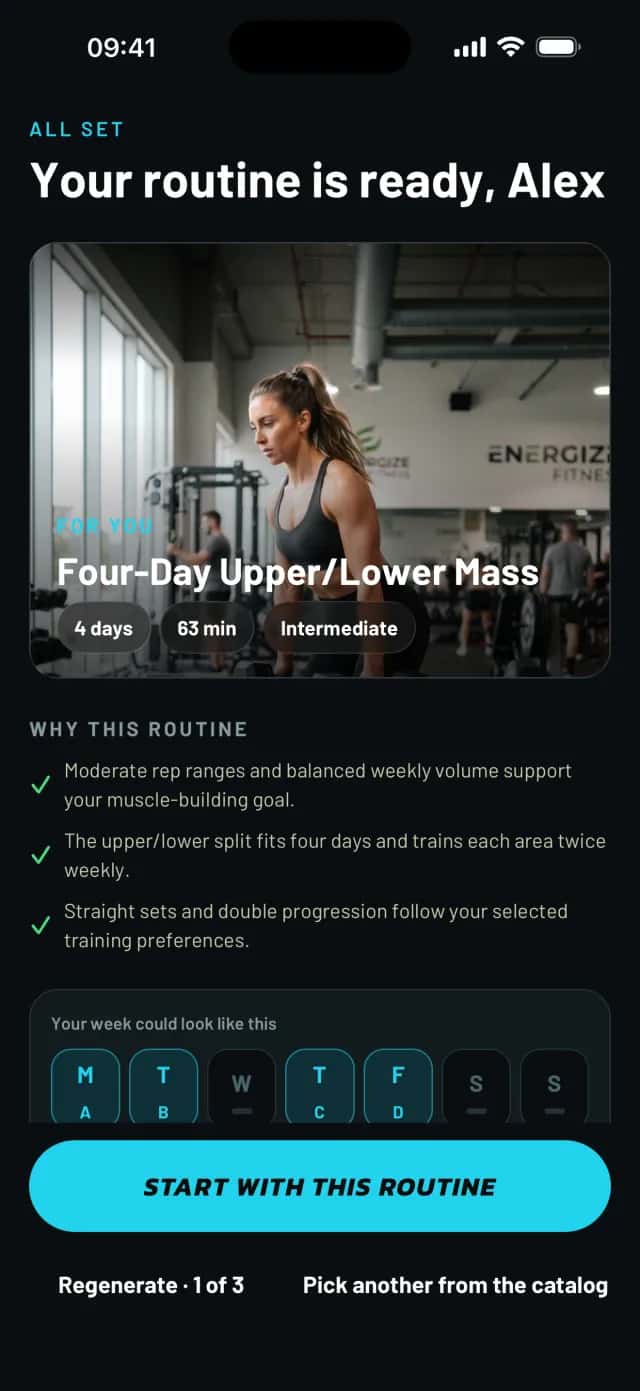
- 4 days. This is the number of days with the most options. Beginner Upper-Legs 4 Days and Intermediate Upper-Legs 4 Days train each muscle twice, and Home with Dumbbells 4 Days is done at home. See the 4-day routines.
- 5 days. Upper-Legs 5 Days adds a weak-point day, and Body part split 5 days gives each muscle group its own day. See the 5-day routines.
- 6 days. Intermediate PPL 6 Days and Arnold split 6 days repeat the cycle twice and spread a lot of volume across manageable sessions. See the 6-day routines.
- I want to prioritize a muscle. Specialization routines raise the sets for one muscle and lower them for others so the session doesn't run long. There are ones for chest, back, shoulders, arms, quads, hamstrings and glutes, and beginner versions for glutes, calves and core.
As for level, if you're just starting out, choose a beginner routine even if you have more days available. The ACSM (2026) points out that many different programs work for beginners, as long as they progress and stick with it. Advanced routines, like PPL 6 days high volume, have more sets and finish closer to failure, which adds fatigue with no advantage if you're still learning the exercises.
| Muscle | Chest specialization | Back specialization | Quad specialization |
|---|---|---|---|
| Chest | 17 over 2 days | 4 over 2 days | 6 over 2 days |
| Back | 6 over 2 days | 19 over 2 days | 6 over 2 days |
| Quads | 11 over 2 days | 11 over 2 days | 18 over 2 days |
In these three, the chosen muscle reaches 17 to 19 weekly sets, close to the point where the ACSM (2026) sees the gain flatten out, and the rest get just enough to maintain. Use them for a while, for a muscle that's lagging, and then go back to a balanced routine.
What the week looks like depending on your days
| Day | 3 days | 4 days | 6 days |
|---|---|---|---|
| Monday | Day A | Upper A | Push A |
| Tuesday | Rest | Lower A | Pull A |
| Wednesday | Day B | Rest | Legs A |
| Thursday | Rest | Upper B | Push B |
| Friday | Day C | Lower B | Pull B |
| Saturday | Rest | Rest | Legs B |
| Sunday | Rest | Rest | Rest |
With full body, leave a rest day between sessions, because each day works the same muscles. With upper-lower or push pull legs you can train on back-to-back days, because each day works different muscles. In all three cases, each muscle gets trained again two or three days later.
If you can't train one day, do the session that was due on the next day and shift the rest. Skipping it leaves a muscle group without work for a whole week.
Common mistakes when training to build muscle
- Taking every set to failure. It doesn't build more muscle than stopping close to it (Refalo et al., 2023), and in one study it delayed recovery by 24 to 48 hours (Morán-Navarro et al., 2017). Leave 1 to 3 reps in reserve on most sets and save failure, if you use it, for the last set of an isolation exercise.
- Changing routines or exercises every week. Repeating the same week lets you compare and add weight. Rotating exercises at random or too often can hold you back (Kassiano et al., 2022). Change an exercise when you have a reason, like a niggle or a long plateau.
- Always doing the short range of motion. Choosing variations that stretch the muscle helps. The overhead triceps extension, like the cable overhead tricep extension, grew the triceps about 1.4 times more than with the arm at your side (Maeo et al., 2023). That's why it shows up in several routines in this list.
- Resting too little to finish sooner. Less than a minute between sets tends to cut volume (Singer et al., 2024). If you're short on time, Upper-lower density 4 days uses supersets, which save time without removing sets.
- Training well and eating too little. To build muscle you need to eat enough protein every day and, in general, a bit more calories than you burn. You don't need a big surplus. The protein calculator gives you the grams for your weight and the calorie calculator a starting point for your goal.
How to progress to keep building muscle
Progressing means doing a little more than last time, with one more rep or a bit more weight. Plotkin et al. (2022) compared raising the load with raising the reps over 8 weeks in trained people, and both approaches worked. The routines in this list use double progression, which combines the two.
- Pick a weight that gets you to the bottom of the range at the indicated RIR. If the routine says 3 × 8–12 at RIR 2, find a weight where you can do at least 8 reps with 2 left in reserve.
- Add reps with that weight, session after session, without changing your technique or range of motion.
- Raise the weight when all sets reach the top of the range. Use the smallest increase available and build up again from the bottom.
If the same exercise appears twice in the week with different ranges, progress each one separately. To choose a starting weight, the 1RM calculator estimates your max and your working weights. The ACSM (2009) gives a similar rule for going up, which is to raise the load by 2 to 10% when you do 1 or 2 more reps than targeted in two sessions in a row.
When a beginner routine stops feeling hard, move to the intermediate one with the same number of days, which adds sets and finishes closer to failure. If performance drops for several sessions in a row, check your sleep and food before adding sets. If it stays the same, do a week with about half the sets and the same load. The consensus from Bell et al. (2023) agrees that a deload lowers the volume, and finds no evidence that you need to schedule one every set number of weeks.
In Mobbe every set is saved. When you train, next to each set you see what you did last session, and in Progress you see your records go up.
Questions about building muscle
How many days a week do I need to build muscle?
With 2 or 3 days you can build muscle if each session works the whole body. More days let you spread more sets without making each session longer. Choose the days you can keep up every week.
How many reps do I need to do to build muscle?
There's no required range. With sets close to failure, muscle grows similarly with heavy or light loads (Schoenfeld et al., 2017). The practical approach is to combine low reps on the main lifts with more reps on isolation exercises, as the routines in this list do.
Is full body or a split routine better?
With the same weekly volume, they give similar results (Ramos-Campo et al., 2024). With few days, full body fits better, and with 4 or more, a split like upper-lower or push pull legs.
Can I do cardio if I want to build muscle?
Yes. In a meta-analysis of 43 studies, adding aerobic exercise didn't hold back muscle or maximal strength (Schumann et al., 2022). If you do them on the same day, lifting first was linked to more leg strength (Murlasits et al., 2018).
How long does it take to see muscle?
It depends on the person. At first strength goes up fast, mostly because you're learning the movements (ACSM, 2009), and muscle shows up more slowly. That's why it helps to follow the progression of your weights and reps, which changes before the mirror does.
Sources
- American College of Sports Medicine. American College of Sports Medicine position stand. Progression models in resistance training for healthy adults. Med Sci Sports Exerc. 2009. doi:10.1249/MSS.0b013e3181915670
- Currier BS, D'Souza AC, Singh MAF, et al. American College of Sports Medicine Position Stand. Resistance training prescription for muscle function, hypertrophy, and physical performance in healthy adults: an overview of reviews. Med Sci Sports Exerc. 2026. doi:10.1249/MSS.0000000000003897
- Bell L, Strafford BW, Coleman M, Androulakis Korakakis P, Nolan D. Integrating deloading into strength and physique sports training programmes: an international Delphi consensus approach. Sports Med Open. 2023. doi:10.1186/s40798-023-00633-0
- Currier BS, Mcleod JC, Banfield L, et al. Resistance training prescription for muscle strength and hypertrophy in healthy adults: a systematic review and Bayesian network meta-analysis. Br J Sports Med. 2023. doi:10.1136/bjsports-2023-106807
- Grgic J, Schoenfeld BJ, Skrepnik M, Davies TB, Mikulic P. Effects of rest interval duration in resistance training on measures of muscular strength: a systematic review. Sports Med. 2018. doi:10.1007/s40279-017-0788-x
- Grgic J, Schoenfeld BJ, Orazem J, Sabol F. Effects of resistance training performed to repetition failure or non-failure on muscular strength and hypertrophy: a systematic review and meta-analysis. J Sport Health Sci. 2022. doi:10.1016/j.jshs.2021.01.007
- Kassiano W, Nunes JP, Costa B, Ribeiro AS, Schoenfeld BJ, Cyrino ES. Does varying resistance exercises promote superior muscle hypertrophy and strength gains? A systematic review. J Strength Cond Res. 2022. doi:10.1519/JSC.0000000000004258
- Maeo S, Wu Y, Huang M, et al. Triceps brachii hypertrophy is substantially greater after elbow extension training performed in the overhead versus neutral arm position. Eur J Sport Sci. 2023. doi:10.1080/17461391.2022.2100279
- Morán-Navarro R, Pérez CE, Mora-Rodríguez R, et al. Time course of recovery following resistance training leading or not to failure. Eur J Appl Physiol. 2017. doi:10.1007/s00421-017-3725-7
- Murlasits Z, Kneffel Z, Thalib L. The physiological effects of concurrent strength and endurance training sequence: a systematic review and meta-analysis. J Sports Sci. 2018. doi:10.1080/02640414.2017.1364405
- Pelland JC, Remmert JF, Robinson ZP, Hinson SR, Zourdos MC. The resistance training dose response: meta-regressions exploring the effects of weekly volume and frequency on muscle hypertrophy and strength gains. Sports Med. 2026. doi:10.1007/s40279-025-02344-w
- Plotkin D, Coleman M, Van Every D, et al. Progressive overload without progressing load? The effects of load or repetition progression on muscular adaptations. PeerJ. 2022. doi:10.7717/peerj.14142
- Ramos-Campo DJ, Benito-Peinado PJ, Andreu-Caravaca L, Rojo-Tirado MA, Rubio-Arias JÁ. Efficacy of split versus full-body resistance training on strength and muscle growth: a systematic review with meta-analysis. J Strength Cond Res. 2024. doi:10.1519/JSC.0000000000004774
- Refalo MC, Helms ER, Trexler ET, Hamilton DL, Fyfe JJ. Influence of resistance training proximity-to-failure on skeletal muscle hypertrophy: a systematic review with meta-analysis. Sports Med. 2023. doi:10.1007/s40279-022-01784-y
- Schoenfeld BJ, Grgic J, Ogborn D, Krieger JW. Strength and hypertrophy adaptations between low- vs. high-load resistance training: a systematic review and meta-analysis. J Strength Cond Res. 2017. doi:10.1519/JSC.0000000000002200
- Schoenfeld BJ, Ogborn D, Krieger JW. Dose-response relationship between weekly resistance training volume and increases in muscle mass: a systematic review and meta-analysis. J Sports Sci. 2017. doi:10.1080/02640414.2016.1210197
- Schoenfeld BJ, Grgic J, Krieger J. How many times per week should a muscle be trained to maximize muscle hypertrophy? A systematic review and meta-analysis of studies examining the effects of resistance training frequency. J Sports Sci. 2019. doi:10.1080/02640414.2018.1555906
- Schumann M, Feuerbacher JF, Sünkeler M, et al. Compatibility of concurrent aerobic and strength training for skeletal muscle size and function: an updated systematic review and meta-analysis. Sports Med. 2022. doi:10.1007/s40279-021-01587-7
- Singer A, Wolf M, Generoso L, et al. Give it a rest: a systematic review with Bayesian meta-analysis on the effect of inter-set rest interval duration on muscle hypertrophy. Front Sports Act Living. 2024. doi:10.3389/fspor.2024.1429789