What makes muscle grow
Muscle grows when you give it a reason to grow and the material to do it. The reason is strength training: the ACSM, which reviewed 137 systematic reviews covering more than 30,000 people, confirms that lifting weights increases muscle size compared with not training (Currier et al., 2026). The material is food: enough protein and a bit more energy than you burn.
- Train with enough volume. The number of hard sets per muscle per week matters most.
- Progress. Do a little more than last time: one more rep or a bit more weight.
- Eat to grow. Protein every day and a small calorie surplus.
- Be consistent. The studies the ACSM pooled last 6 to 52 weeks. Muscle responds to months of work, not to one perfect week.
How to train to build muscle
More weekly sets mean more growth. In a meta-analysis, each extra set per week added 0.37% muscle gain on average (Schoenfeld et al., 2017), and the ACSM links the most hypertrophy to 10 or more sets per muscle per week (Currier et al., 2026). But the curve flattens: across 67 studies, each additional set adds a little less than the one before (Pelland et al., 2026).
| Variable | What to do | Why |
|---|---|---|
| Sets per muscle | 10 or more per week | It is the number the ACSM links to more hypertrophy |
| Effort | Hard sets, with no need to reach failure | Going to failure did not build more muscle than stopping a little short |
| Load | Heavy or moderate, depending on the exercise | With sets near failure, muscle grows about the same with heavy or light loads |
| Frequency | Whatever lets you spread out your sets | With the same volume, training more days does not change growth |
On effort, a meta-analysis found no advantage in taking sets to muscular failure over stopping before it (Refalo et al., 2023). On load, muscle grew about the same with weights up to 60% of your max and with heavier ones, although maximal strength went up more with heavy weights (Schoenfeld et al., 2017). On frequency, with the same volume it makes no difference whether you train a muscle once, twice or three times a week, so pick what fits your schedule (Schoenfeld et al., 2019).
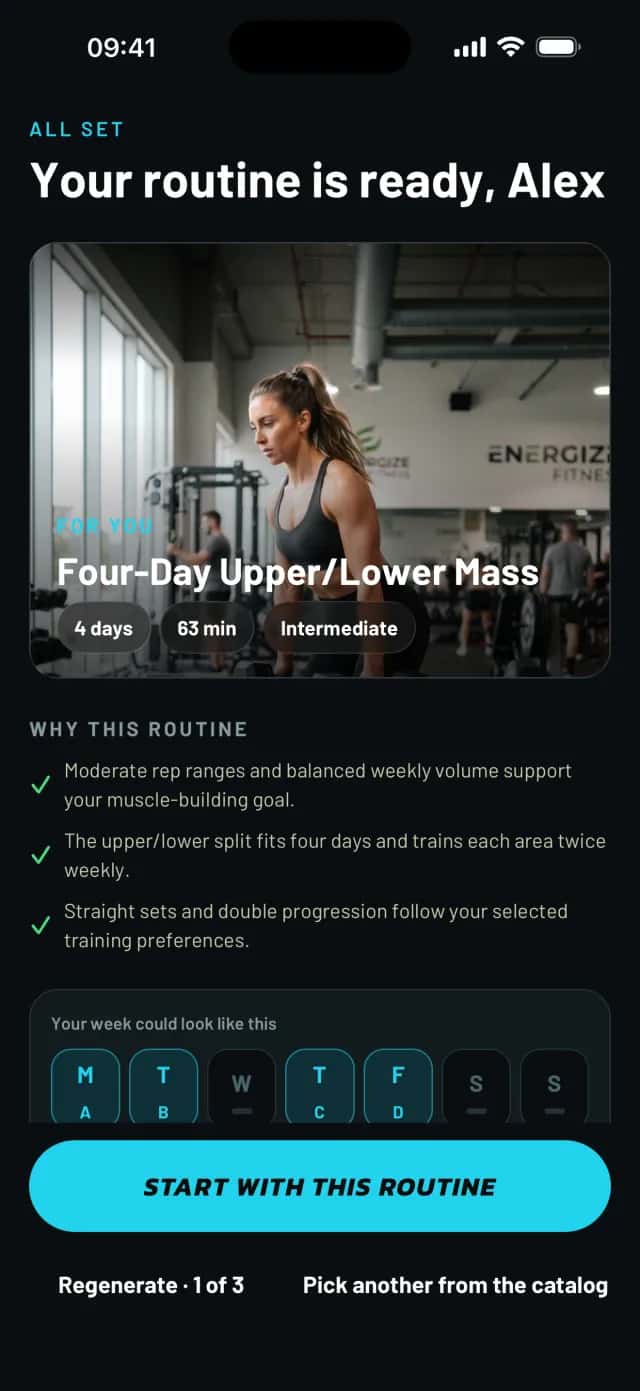
In practice, build your week around compound lifts like the barbell squat or the barbell row and add accessories to reach your sets for each muscle. If you would rather not plan it yourself, the muscle building routines already have the volume counted for your days and level.
How much to eat to build muscle
- Find your maintenance. It is the calories you burn in a day. The calorie calculator works it out from your age, height, weight and activity. For the details, see the guide on calories per day.
- Add 10% to 20%. That is the surplus recommended to build muscle without adding extra fat, with weight gain of 0.25% to 0.5% per week. If you have been lifting for years, stay at the low end (Iraki et al., 2019).
- Get your protein. 1.6 to 2.2 g per kg of body weight per day, spread over 3 to 6 meals (Iraki et al., 2019). Above about 1.6 g per kg, on average, extra protein added no more lean mass (Morton et al., 2018). Work out yours with the protein calculator.
Example: if you weigh 70 kg (154 lb) and your maintenance is 2,500 calories, a 10% to 20% surplus is 250 to 500 calories more, or about 2,750 to 3,000 calories a day. For protein, 70 × 1.6 = 112 g to 70 × 2.2 = 154 g. Your weight should go up 0.18 to 0.35 kg (0.4 to 0.8 lb) per week (0.25% to 0.5% of 70 kg), about 0.7 to 1.4 kg (1.5 to 3 lb) per month.
Weigh yourself several mornings a week and look at the average. If it has not gone up in two or three weeks, add about 100 to 200 calories; if it goes up faster than planned, take off the same. Not all of that weight is muscle: in overfeeding studies, 60% to 70% of the weight gained by thin people was lean tissue, and only 30% to 40% in people with obesity (Forbes, 2000).
How to progress week by week
The ACSM calls for training to be progressive (Currier et al., 2026). In trained people, adding weight and adding reps both worked over 8 weeks (Plotkin et al., 2022). The simplest way to combine both is double progression.
- Pick a rep range. For example, 3 sets of 8 to 12. Find a weight you can do 8 reps with, with effort.
- Add reps. With the same weight, try to do one more rep in some set each session, without changing your form.
- Add weight. When every set reaches 12, use the smallest increase available and start again from 8.
Log every session, on paper or in an app, so you know what to beat next time. To choose your starting weight, the 1RM calculator estimates your max and your working weights.
Common mistakes when trying to build muscle
- Eating too little. Training well without a surplus or enough protein slows growth, especially if you are already lean.
- Eating too much. Gaining more than 0.5% of your weight per week adds mostly fat, which you will later have to lose with a calorie deficit.
- Switching routines all the time. If every week is different, you cannot compare or progress. Stick with the same routine for several months.
- Too few sets. Two or three sets per muscle per week fall well short of the 10 or more the ACSM links to more hypertrophy.
Questions
How long does it take to see muscle gains?
The studies the ACSM pooled last 6 to 52 weeks, and in them strength training already increases muscle size (Currier et al., 2026). At 0.25% to 0.5% of your body weight per week, in three months a 70 kg (154 lb) person gains about 2 to 4.5 kg (5 to 10 lb), and part of it is muscle.
Can you build muscle without gaining weight?
It is possible, especially if you are new to lifting or carry more body fat: the more fat you have, the smaller the share of muscle you lose when you lose weight (Forbes, 2000). If you have been training for a while, a small surplus is what is recommended to build muscle (Iraki et al., 2019).
Can you build muscle working out at home?
Yes. With sets near failure, muscle grows about the same with light and heavy loads (Schoenfeld et al., 2017), so dumbbells, bands or your own body weight work as long as you progress. See the [at-home routines](lista:en-casa).
Do I need supplements to build muscle?
No. The main things are training, eating enough and getting your protein. Among the few that might help is creatine monohydrate, 3 to 5 g a day (Iraki et al., 2019). If you struggle to reach your protein with food, a shake can top it up.
Sources
- Currier BS, D'Souza AC, Singh MAF, et al. American College of Sports Medicine Position Stand. Resistance training prescription for muscle function, hypertrophy, and physical performance in healthy adults: an overview of reviews. Med Sci Sports Exerc. 2026;58(4):851-872. doi:10.1249/MSS.0000000000003897
- Schoenfeld BJ, Ogborn D, Krieger JW. Dose-response relationship between weekly resistance training volume and increases in muscle mass: a systematic review and meta-analysis. J Sports Sci. 2017;35(11):1073-1082. doi:10.1080/02640414.2016.1210197
- Pelland JC, Remmert JF, Robinson ZP, Hinson SR, Zourdos MC. The resistance training dose response: meta-regressions exploring the effects of weekly volume and frequency on muscle hypertrophy and strength gains. Sports Med. 2026;56(2):481-505. doi:10.1007/s40279-025-02344-w
- Refalo MC, Helms ER, Trexler ET, Hamilton DL, Fyfe JJ. Influence of resistance training proximity-to-failure on skeletal muscle hypertrophy: a systematic review with meta-analysis. Sports Med. 2023;53(3):649-665. doi:10.1007/s40279-022-01784-y
- Schoenfeld BJ, Grgic J, Ogborn D, Krieger JW. Strength and hypertrophy adaptations between low- vs. high-load resistance training: a systematic review and meta-analysis. J Strength Cond Res. 2017;31(12):3508-3523. doi:10.1519/JSC.0000000000002200
- Schoenfeld BJ, Grgic J, Krieger J. How many times per week should a muscle be trained to maximize muscle hypertrophy? A systematic review and meta-analysis of studies examining the effects of resistance training frequency. J Sports Sci. 2019;37(11):1286-1295. doi:10.1080/02640414.2018.1555906
- Plotkin D, Coleman M, Van Every D, et al. Progressive overload without progressing load? The effects of load or repetition progression on muscular adaptations. PeerJ. 2022;10:e14142. doi:10.7717/peerj.14142
- Iraki J, Fitschen P, Espinar S, Helms E. Nutrition recommendations for bodybuilders in the off-season: a narrative review. Sports (Basel). 2019;7(7):154. doi:10.3390/sports7070154
- Morton RW, Murphy KT, McKellar SR, et al. A systematic review, meta-analysis and meta-regression of the effect of protein supplementation on resistance training-induced gains in muscle mass and strength in healthy adults. Br J Sports Med. 2018;52(6):376-384. doi:10.1136/bjsports-2017-097608
- Forbes GB. Body fat content influences the body composition response to nutrition and exercise. Ann N Y Acad Sci. 2000;904:359-365. doi:10.1111/j.1749-6632.2000.tb06482.x
This guide is for information only and does not replace advice from a health professional.