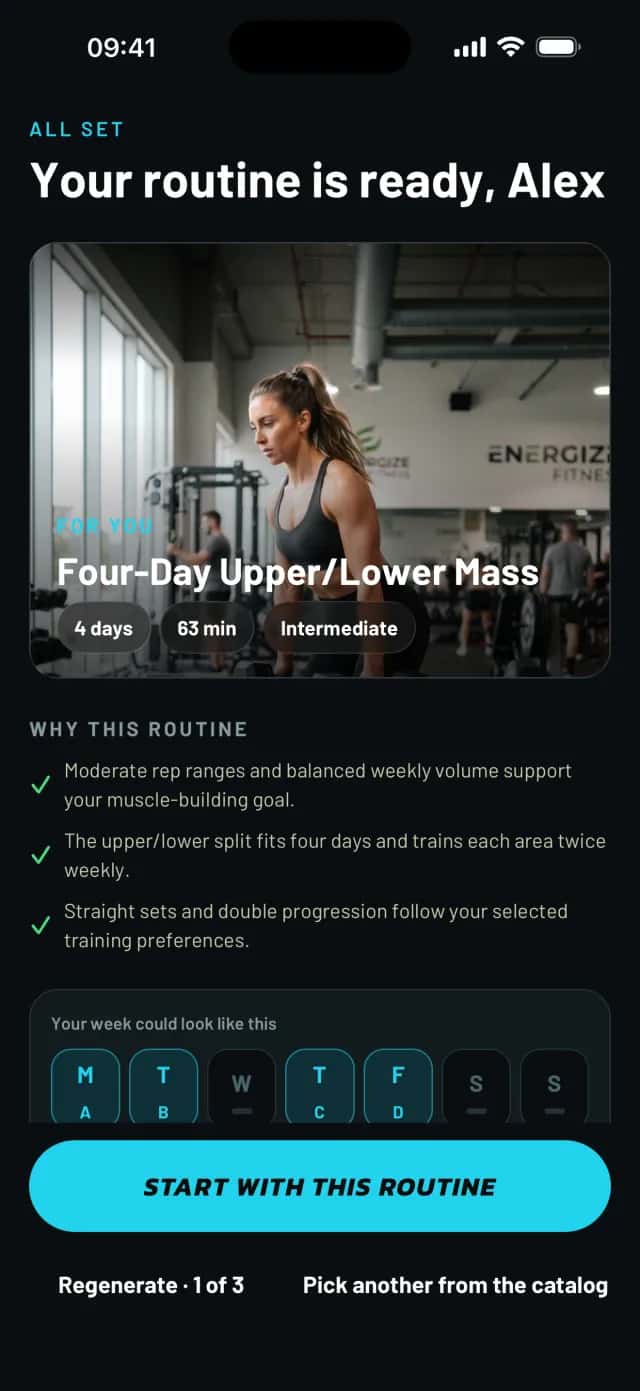
What is a full body routine
A full body routine works all the large muscle groups in every session. Each day includes at least one leg exercise, one push and one pull, and depending on your time it adds hips, shoulders, arms or core. Since every session hits the whole body, each muscle is trained as many times a week as the days you train.
A session usually has 4 to 6 exercises with few sets each. For example, a barbell squat, a dumbbell bench press, a lat pulldown, a Romanian deadlift and a shoulder press.
It is the classic format for starting out. The ACSM (2009) recommends that beginners train the whole body 2 or 3 days a week. The 2026 ACSM clarifies that this recommendation was based on only three studies with 59 people. It is a good option to start with, though not the only one.
It is not just for beginners either. In trained men, training each muscle 3 times a week with full body gave more thickness in the elbow flexors than a one-muscle-group-per-day routine, with no differences in strength (Schoenfeld et al., 2015). With the same volume, full body and splits perform similarly (Ramos-Campo et al., 2024).
How to spread the days across the week
Leave a day off between sessions. Since every day works the same muscles, the studies with beginners used alternate days (ACSM, 2009), and training the whole body on consecutive days may not let you recover.
| Day | 2 days | 3 days |
|---|---|---|
| Monday | Day A | Day A |
| Tuesday | Rest | Rest |
| Wednesday | Rest | Day B |
| Thursday | Day B | Rest |
| Friday | Rest | Day C |
| Saturday | Rest | Rest |
| Sunday | Rest | Rest |
With 3 days it helps to have three different sessions, A, B and C. The classic A/B alternates A, B and A one week and B, A and B the next. If you always repeat the same week, A comes up twice and B once.
The different days don't have to change everything. The usual approach is to repeat the main lifts with a different rep range and swap the accessories for others that work the muscle from another angle. Varying with that criterion may help different areas of the muscle grow, and rotating too much or randomly can backfire (Kassiano et al., 2022).
With 4 days or more, a full body routine forces you to train the whole body on consecutive days. From there, an upper lower split, which alternates the halves, is usually the better fit.
Who full body is for
- Anyone starting out. You learn a few exercises and repeat them several times a week. At the beginning strength goes up mostly because you learn the movement (ACSM, 2009). Beginner Full Body 3 Days is designed for that.
- Anyone with 2 or 3 days. With few days, full body is the way to train each muscle more than once a week. Beginner Full Body 2 Days works everything in two sessions.
- Anyone coming back after a break. Back to the Gym 3 Days starts with fewer sets and builds up little by little.
- Anyone who trains at home. Home Bodyweight 3 Days is done with your body weight, a pull-up bar and resistance bands.
- Anyone who wants to lose fat. Weights help you keep muscle while you eat less. In people with overweight, combining strength training with fewer calories lowered body fat percentage the most, and kept lean mass (Lopez et al., 2022). Check out the cutting routines and the calorie calculator.
Volume and frequency per muscle
Volume is the number of hard sets each muscle does per week. It is what matters most for building muscle, with a dose-response relationship in which more sets give more growth (Schoenfeld, Ogborn and Krieger, 2017). The ACSM (2026) associates the greatest hypertrophy with 10 or more sets per muscle per week.
In full body that total is spread across the days. With 3 days, 10 sets of chest is 3 or 4 per session. With 2 days it is 5 per session, and there the session starts to run long, because each day also includes legs, back and shoulders. That is the limit of full body, because adding volume means making sessions longer.
When you're starting out you don't need to reach 10. In a comparison of 12 ways of training, all of them grew muscle similarly, and the multiple-set ones ranked better (Currier et al., 2023). That's why beginner routines start with fewer sets.
Full body frequency is high by design. With 3 days, each muscle is trained three times. With the same volume, that doesn't give more muscle than training it once or twice (Schoenfeld, Grgic and Krieger, 2019). What it adds is spreading the work. Each session has few sets per muscle and is done with less fatigue, and you practice the main lifts several times a week, something that seems to help gain strength in them (Pelland et al., 2026).
| Muscle | Beginner Full Body 2 Days | Beginner Full Body 3 Days | Intermediate Full Body 3 Days |
|---|---|---|---|
| Chest | 6 over 2 days | 9 over 3 days | 6 over 2 days |
| Back | 6 over 2 days | 9 over 3 days | 6 over 2 days |
| Shoulders | 2 over 1 day | 4 over 2 days | 6 over 2 days |
| Quads | 6 over 2 days | 9 over 3 days | 8 over 2 days |
| Hamstrings | 6 over 2 days | 6 over 2 days | 7 over 2 days |
The table counts the sets where each muscle is the primary mover and the days it is trained. The main lifts also add to other muscles, like the chest press to the triceps and the squat to the glutes.
Sets count if they are hard. You don't need to reach failure, and the ACSM (2026) proposes finishing with 2 or 3 reps in reserve. If you're just starting out, staying a bit further from failure lets you focus on technique while you learn.
Common mistakes with full body
- Cramming in too many exercises. A ten-exercise full body takes a long time and the last ones are done with little energy. If the session runs long, cut accessories and keep the main lifts.
- Changing exercises every week. Repeating the same week lets you compare and raise the weight. Randomly varying exercises every session did not give more muscle (Baz-Valle et al., 2019).
- Training without logging. Without a log it is easy to forget what weight and how many reps you finished with, and double progression depends on that data. Log every set.
- Resting less than a minute to finish sooner. Less than 60 seconds between sets tends to cut volume (Singer et al., 2024). If you're short on time, short routines like Express Full Body 3 Days use supersets, which save time without removing sets.
How to progress with full body
Mobbe's full body routines with weights use double progression. At first you'll go up fast and later the pace slows, and that's normal.
- Pick a comfortable weight that lets you reach the bottom of the range with the reps in reserve the routine indicates.
- Add reps with that weight every session, without losing technique.
- Raise the weight when all sets reach the top of the range. Use the smallest increase you have and go back to the bottom.
If you squat twice a week with different ranges, progress each one separately. Plotkin et al. (2022) saw that adding reps or adding load work similarly, so you don't need to raise the weight every session.
In Home Bodyweight 3 Days, when you complete the top of the range on all sets you move on to the harder variation of the exercise. At the gym, the 1RM calculator helps you choose your starting weight based on your reps.
If progress stalls for several sessions in a row, check your sleep and food before adding sets. If it stays the same, a week with fewer sets and the same load lowers fatigue without stopping training (Bell et al., 2023). In Mobbe every set is saved and, when you train, you see what you did in the previous session so you know what to beat.
Questions about full body
Can I do full body every day?
You can, if you spread the week's sets across shorter sessions instead of adding more. For most people, 2 or 3 days with a day off between sessions is easier to sustain.
What do I do if I miss a day?
Do the session you missed on your next available day, leaving a day off before the next one. If they pile up, do only one and continue from there.
Can I do cardio with a full body routine?
Yes. In a meta-analysis of 43 studies, adding aerobic exercise did not hold back muscle or maximal strength (Schumann et al., 2022). If you do both on the same day, lifting first was associated with more leg strength (Murlasits et al., 2018).
Sources
- American College of Sports Medicine. American College of Sports Medicine position stand. Progression models in resistance training for healthy adults. Med Sci Sports Exerc. 2009. doi:10.1249/MSS.0b013e3181915670
- Currier BS, D'Souza AC, Singh MAF, et al. American College of Sports Medicine Position Stand. Resistance training prescription for muscle function, hypertrophy, and physical performance in healthy adults: an overview of reviews. Med Sci Sports Exerc. 2026. doi:10.1249/MSS.0000000000003897
- Baz-Valle E, Schoenfeld BJ, Torres-Unda J, Santos-Concejero J, Balsalobre-Fernández C. The effects of exercise variation in muscle thickness, maximal strength and motivation in resistance trained men. PLoS One. 2019. doi:10.1371/journal.pone.0226989
- Bell L, Strafford BW, Coleman M, Androulakis Korakakis P, Nolan D. Integrating deloading into strength and physique sports training programmes: an international Delphi consensus approach. Sports Med Open. 2023. doi:10.1186/s40798-023-00633-0
- Currier BS, Mcleod JC, Banfield L, et al. Resistance training prescription for muscle strength and hypertrophy in healthy adults: a systematic review and Bayesian network meta-analysis. Br J Sports Med. 2023. doi:10.1136/bjsports-2023-106807
- Kassiano W, Nunes JP, Costa B, Ribeiro AS, Schoenfeld BJ, Cyrino ES. Does varying resistance exercises promote superior muscle hypertrophy and strength gains? A systematic review. J Strength Cond Res. 2022. doi:10.1519/JSC.0000000000004258
- Lopez P, Taaffe DR, Galvão DA, et al. Resistance training effectiveness on body composition and body weight outcomes in individuals with overweight and obesity across the lifespan: a systematic review and meta-analysis. Obes Rev. 2022. doi:10.1111/obr.13428
- Murlasits Z, Kneffel Z, Thalib L. The physiological effects of concurrent strength and endurance training sequence: a systematic review and meta-analysis. J Sports Sci. 2018. doi:10.1080/02640414.2017.1364405
- Pelland JC, Remmert JF, Robinson ZP, Hinson SR, Zourdos MC. The resistance training dose response: meta-regressions exploring the effects of weekly volume and frequency on muscle hypertrophy and strength gains. Sports Med. 2026. doi:10.1007/s40279-025-02344-w
- Plotkin D, Coleman M, Van Every D, et al. Progressive overload without progressing load? The effects of load or repetition progression on muscular adaptations. PeerJ. 2022. doi:10.7717/peerj.14142
- Ramos-Campo DJ, Benito-Peinado PJ, Andreu-Caravaca L, Rojo-Tirado MA, Rubio-Arias JÁ. Efficacy of split versus full-body resistance training on strength and muscle growth: a systematic review with meta-analysis. J Strength Cond Res. 2024. doi:10.1519/JSC.0000000000004774
- Schoenfeld BJ, Ratamess NA, Peterson MD, Contreras B, Tiryaki-Sonmez G. Influence of resistance training frequency on muscular adaptations in well-trained men. J Strength Cond Res. 2015. doi:10.1519/JSC.0000000000000970
- Schoenfeld BJ, Ogborn D, Krieger JW. Dose-response relationship between weekly resistance training volume and increases in muscle mass: a systematic review and meta-analysis. J Sports Sci. 2017. doi:10.1080/02640414.2016.1210197
- Schoenfeld BJ, Grgic J, Krieger J. How many times per week should a muscle be trained to maximize muscle hypertrophy? A systematic review and meta-analysis of studies examining the effects of resistance training frequency. J Sports Sci. 2019. doi:10.1080/02640414.2018.1555906
- Schumann M, Feuerbacher JF, Sünkeler M, et al. Compatibility of concurrent aerobic and strength training for skeletal muscle size and function: an updated systematic review and meta-analysis. Sports Med. 2022. doi:10.1007/s40279-021-01587-7
- Singer A, Wolf M, Generoso L, et al. Give it a rest: a systematic review with Bayesian meta-analysis on the effect of inter-set rest interval duration on muscle hypertrophy. Front Sports Act Living. 2024. doi:10.3389/fspor.2024.1429789