Calorie calculator: how many you need a day
Calculate your maintenance calories and how many to eat to lose, maintain or gain weight, with the same method the Mobbe app uses. And compare it with Mifflin-St Jeor and Harris-Benedict.
It's an estimate, not a measurement. In the app, reviews compare it with your real weight and suggest adjustments. It doesn't replace a professional: during pregnancy or breastfeeding, or with an eating disorder, diabetes, kidney disease or weight-loss treatment, the app doesn't calculate targets and suggests seeing a professional.
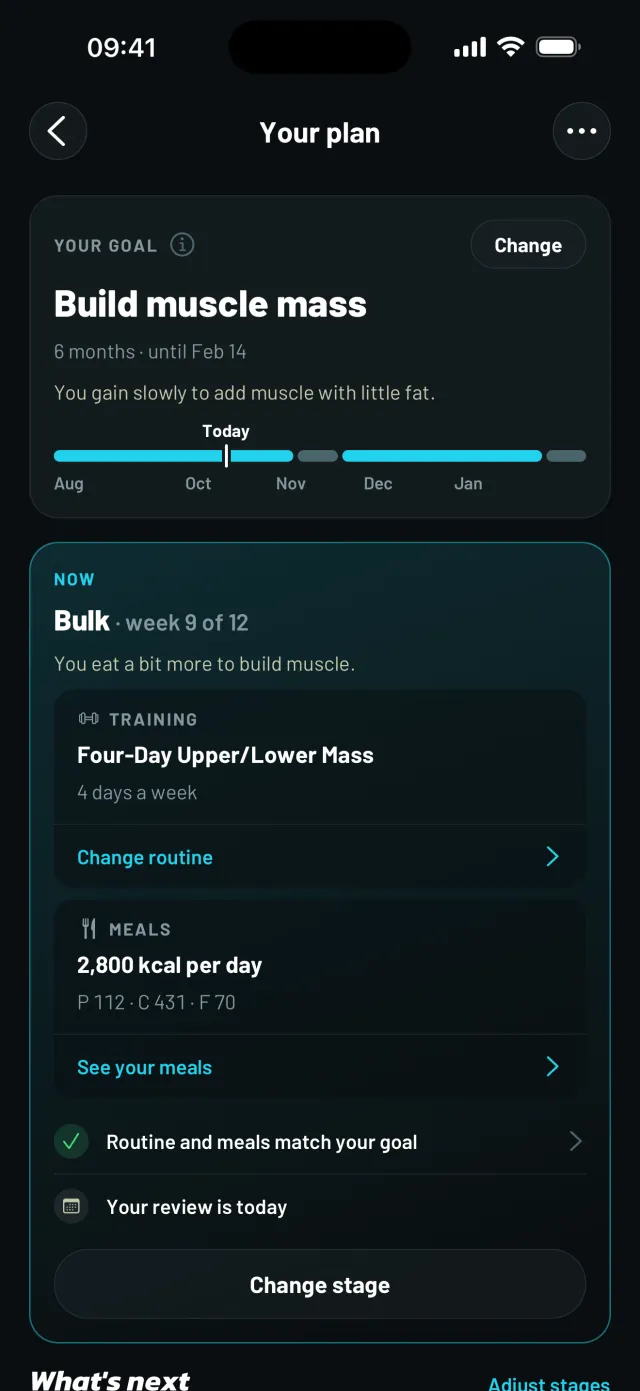
Take it to your plan. Mobbe builds your routine for free and, with PRO, your meal plan with these calories.
How we calculate
It's the same calculation the Mobbe app does for your daily target, step by step and with the worked example.
- Step 1
Your resting expenditure
What your body burns without moving, with the Mifflin-St Jeor equation. In the example (a 30-year-old man, 180 cm and 85 kg) it comes to 1,830 kcal.
10 × weight (kg) + 6.25 × height (cm) − 5 × age + 5 for men or − 161 for womenMifflin and St Jeor, 1990. The most accurate equation in healthy adults, with and without obesity (Frankenfield, 2005). - Step 2
Your activity level
Resting expenditure is multiplied by 1.5 (lightly active), 1.6 (moderately active), 1.75 (very active) or 1.9 (athlete). With 0 to 2 training days we suggest light; with 3 to 5, moderate; with 6 or 7, very active. Training is already part of the level: it isn't added on top. In the example: 1,830 × 1.6 = 2,928, which we round to 2,950 kcal.
NASEM, 2023: total expenditure measured with doubly labeled water, turned into multiples of Mifflin. Pontzer, 2016. - Step 3
Your pace to lose or gain
The pace is a share of your weight per week. To lose: 0.5% (sustainable), 0.75% (recommended) or 1% (aggressive). To gain: 0.25% (sustainable) or 0.5% (fast). Each kilo is about 7,700 kcal. In the example, 0.75% of 85 kg is 0.64 kg a week, about 701 kcal less a day: 2,928 − 701 = 2,227, which we round to 2,250 kcal.
kg per week × 7,700 ÷ 7 = kcal difference per dayHelms, 2014; Garthe, 2011; Iraki, 2019 (paces). Hall, 2008; Thomas, 2013 (kcal per kilo). - Step 4
The safety limits
Never below 1,200 kcal for women or 1,500 for men. A deficit of up to 1,000 kcal a day (500 from age 65). The aggressive pace only with a BMI of 25 or more, and from age 65 only the sustainable one. If you want to lose with a BMI under 20 (or under 30 from age 65), or gain with a BMI of 30 or more, the target stays at maintenance. We don't calculate targets for anyone under 18.
Argentine obesity guideline, 2013; AHA/ACC/TOS, 2013; NHLBI, 1998; ESPEN, 2022; Forbes, 2000; GLIM, 2019.
No sedentary level. Mobbe's lowest factor is 1.5 because the app is made for people who train; if you barely move and don't train, your expenditure may be lower. Revised Harris-Benedict (Roza and Shizgal, 1984): 88.362 + 13.397 × weight + 4.799 × height − 5.677 × age for men and 447.593 + 9.247 × weight + 3.098 × height − 4.330 × age for women.
Sources
- Mifflin MD, St Jeor ST, Hill LA, Scott BJ, Daugherty SA, Koh YO. A new predictive equation for resting energy expenditure in healthy individuals. Am J Clin Nutr. 1990;51(2):241-247. doi:10.1093/ajcn/51.2.241
- Frankenfield D, Roth-Yousey L, Compher C. Comparison of predictive equations for resting metabolic rate in healthy nonobese and obese adults: a systematic review. J Am Diet Assoc. 2005;105(5):775-789. doi:10.1016/j.jada.2005.02.005
- National Academies of Sciences, Engineering, and Medicine. Dietary Reference Intakes for Energy. Washington, DC: The National Academies Press; 2023. doi:10.17226/26818
- Pontzer H, Durazo-Arvizu R, Dugas LR, et al. Constrained total energy expenditure and metabolic adaptation to physical activity in adult humans. Curr Biol. 2016;26(3):410-417. doi:10.1016/j.cub.2015.12.046
- Roza AM, Shizgal HM. The Harris Benedict equation reevaluated: resting energy requirements and the body cell mass. Am J Clin Nutr. 1984;40(1):168-182. doi:10.1093/ajcn/40.1.168
- Helms ER, Aragon AA, Fitschen PJ. Evidence-based recommendations for natural bodybuilding contest preparation: nutrition and supplementation. J Int Soc Sports Nutr. 2014;11:20. doi:10.1186/1550-2783-11-20
- Garthe I, Raastad T, Refsnes PE, Koivisto A, Sundgot-Borgen J. Effect of two different weight-loss rates on body composition and strength and power-related performance in elite athletes. Int J Sport Nutr Exerc Metab. 2011;21(2):97-104. doi:10.1123/ijsnem.21.2.97
- Iraki J, Fitschen P, Espinar S, Helms E. Nutrition recommendations for bodybuilders in the off-season: a narrative review. Sports (Basel). 2019;7(7):154. doi:10.3390/sports7070154
- Hall KD. What is the required energy deficit per unit weight loss? Int J Obes. 2008;32(3):573-576. doi:10.1038/sj.ijo.0803720
- Thomas DM, Martin CK, Lettieri S, et al. Can a weight loss of one pound a week be achieved with a 3500-kcal deficit? Int J Obes. 2013;37(12):1611-1613. doi:10.1038/ijo.2013.51
- Ministerio de Salud de la Nación (Argentina). Guía de Práctica Clínica Nacional sobre Diagnóstico y Tratamiento de la Obesidad en adultos. Buenos Aires; 2013.
- Jensen MD, Ryan DH, Apovian CM, et al. 2013 AHA/ACC/TOS guideline for the management of overweight and obesity in adults. Circulation. 2014;129(25 Suppl 2):S102-S138. doi:10.1161/01.cir.0000437739.71477.ee
- National Heart, Lung, and Blood Institute. Clinical Guidelines on the Identification, Evaluation, and Treatment of Overweight and Obesity in Adults: The Evidence Report. NIH Publication No. 98-4083; 1998.
- Volkert D, Beck AM, Cederholm T, et al. ESPEN practical guideline: clinical nutrition and hydration in geriatrics. Clin Nutr. 2022;41(4):958-989. doi:10.1016/j.clnu.2022.01.024
- Forbes GB. Body fat content influences the body composition response to nutrition and exercise. Ann N Y Acad Sci. 2000;904:359-365. doi:10.1111/j.1749-6632.2000.tb06482.x
- Cederholm T, Jensen GL, Correia MITD, et al. GLIM criteria for the diagnosis of malnutrition. J Cachexia Sarcopenia Muscle. 2019;10(1):207-217. doi:10.1002/jcsm.12383
Frequently asked questions
How many calories do I need a day?
It depends on your weight, height, age, sex and how much you move. A 30-year-old man, 180 cm and 85 kg, who trains 4 days a week burns about 2,950 kcal a day; a 30-year-old woman, 165 cm and 62 kg, who trains 3 days, about 2,150 kcal. That's what keeps your weight steady: to lose you eat less, and to gain, a little more.
How many calories should I eat to lose weight?
Your maintenance minus a deficit based on the pace: Mobbe suggests losing between 0.5% and 1% of your weight a week, with a deficit of up to 1,000 kcal a day and never below 1,200 kcal for women or 1,500 for men. For the man in the example, at the recommended pace that's 2,250 kcal a day.
How many calories do I need to build muscle?
A little more than your maintenance: Mobbe suggests gaining 0.25% of your weight a week, because gaining faster adds more fat than muscle. For the man in the example that's 3,150 kcal a day, 200 more than his maintenance.
Which is better, Harris-Benedict or Mifflin-St Jeor?
For resting expenditure, Mifflin-St Jeor: in Frankenfield's review (2005) it was the most accurate equation in healthy adults, with and without obesity. The revised Harris-Benedict tends to give a bit more. The calculator shows both with the classic activity factors so you can compare them with Mobbe's method.
Why does Mobbe give more calories than other calculators?
Because of the activity factors. Almost every calculator uses 1.375, 1.55, 1.725 and 1.9, which underestimate the expenditure measured with doubly labeled water. Mobbe uses 1.5, 1.6, 1.75 and 1.9, which come from those measurements (NASEM 2023). Also, Mobbe has no sedentary level: if you barely move and don't train, your real expenditure may be lower than what you see here.
How often should I recalculate my calories?
When your weight changes by a few kilos or you change your goal, because the calculation starts from your current weight. In the Mobbe app, reviews take care of it: they compare your target with your real weight and suggest adjustments.
Guides to get more out of it
More calculators and routines
- Macro calculatorGrams of protein, carbs, fat and fiber for your goal, within your calories.Calculate →
- Protein calculatorGrams of protein a day based on your weight and your goal, with a 50 to 100 kg table.Calculate →
- 1RM calculatorYour one-rep max with Epley and Brzycki, by RIR or RPE, and your training weights from 50 to 100%.Calculate →
Mobbe builds your plan with these numbers
Download Mobbe and answer a few questions: it builds your routine for free and, with PRO, your meal plan with grams and macros comes from these same calculations. At every review it's compared with your real weight and adjusted.