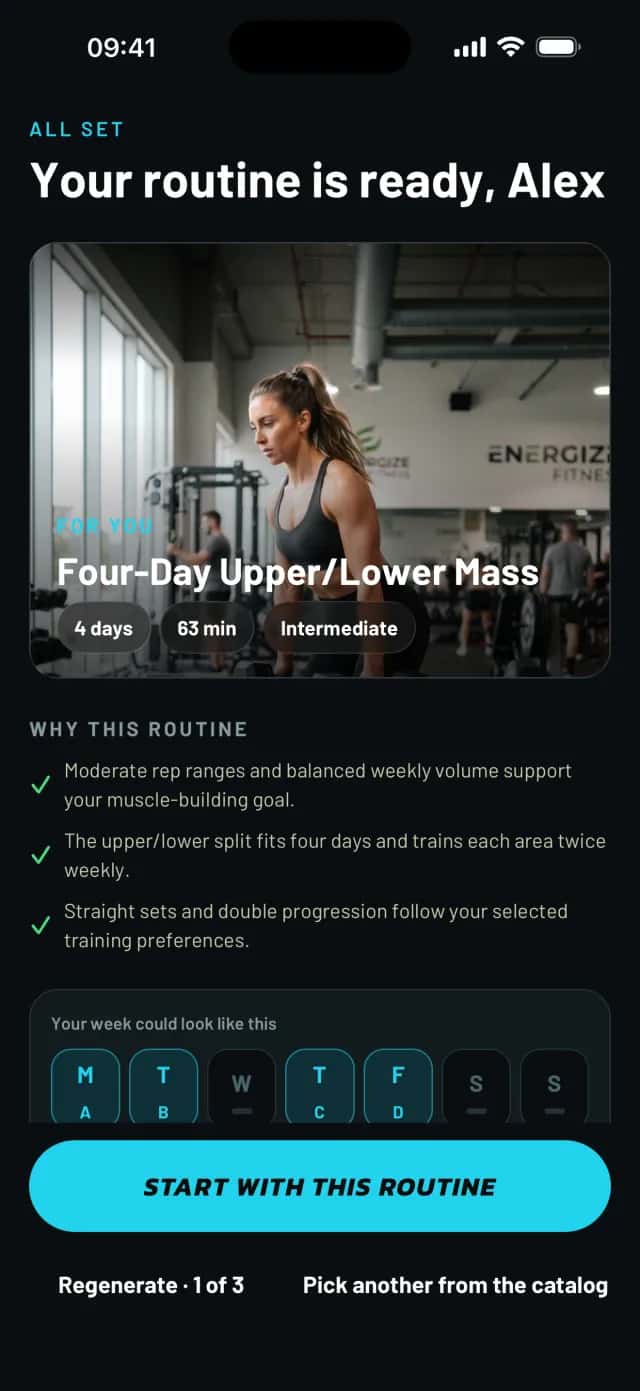
What is an upper lower split routine
An upper lower split routine divides the body into two halves trained on different days. The upper day works the chest, back, shoulders and arms, with push and pull exercises. The lower day works the quadriceps, hamstrings, glutes and calves, with a knee-dominant exercise like the barbell squat and a hip-dominant one like the Romanian deadlift or the hip thrust.
The classic version has 4 days, two upper and two lower, and every muscle is trained twice a week. It is what the ACSM (2009) proposes for the intermediate level when a 4-day split is used.
Compared with full body, each session works half of the muscles. That leaves more sets per area on each day and more focused sessions. With the same weekly volume, results are similar. In a trial with women with no previous experience, 4 upper lower sessions gave the same strength and muscle mass improvements as 2 full body sessions with the same weekly sets (Pedersen et al., 2022). A meta-analysis of 14 studies on splits in general arrives at the same conclusion (Ramos-Campo et al., 2024).
How to spread the days across the week
With 4 days, alternate upper and lower and leave a day off in the middle of the week. That way you never train the same half two days in a row, and each one rests about 72 hours before repeating.
| Day | 4 days | 5 days | 6 days |
|---|---|---|---|
| Monday | Upper A | Upper A | Upper A |
| Tuesday | Lower A | Lower A | Lower A |
| Wednesday | Rest | Rest | Upper B |
| Thursday | Upper B | Upper B | Lower B |
| Friday | Lower B | Lower B | Upper C |
| Saturday | Rest | Upper C | Lower C |
| Sunday | Rest | Rest | Rest |
With 5 days, the fifth session repeats one half or is dedicated to whatever you most want to improve, as in Upper-Lower 5 Days. With 6 days, each half is trained three times and the week's sets are spread across shorter sessions.
With 3 days, the upper lower split comes out uneven. A fixed week of upper, lower and upper trains one half twice and the other once. For 3 days a full body routine or a push pull legs routine fits better.
Within each day, start with the exercise that matters most to you. The one that goes first is the one that gains the most strength (Nunes et al., 2021). For building muscle, the order matters little.
Who the upper lower split is for
- Intermediate level with 4 days. You already know the main lifts and want more sets per area than fit in a full body routine.
- Beginners who already have 4 days. You don't need to go through a full body routine first. Beginner Upper-Lower 4 Days uses the main lifts of each pattern and few sets.
- Advanced lifters with 5 or 6 days. With more days, more sets per muscle fit without making each session longer, as in Advanced Upper-Lower 6 Days.
- Anyone who wants to prioritize a muscle. The specializations in this list keep the upper and lower layout and raise the sets of the chosen muscle, like Glutes Specialization · Beginner or Back Specialization.
- Anyone who trains at home. Home with Dumbbells 4 Days uses the same layout with dumbbells, a bench and your body weight.
Volume and frequency per muscle
To build muscle, what matters most is how many hard sets each muscle does per week. More sets, more growth, in a dose-response relationship (Schoenfeld, Ogborn and Krieger, 2017). The ACSM (2026) associates the greatest hypertrophy with 10 or more sets per muscle per week, and sees the gain flatten around 18 to 20. Beyond that, Baz-Valle et al. (2022) saw no differences in quadriceps or biceps, although they did in triceps.
With 4 days, reaching 10 weekly sets of chest takes 5 per session, and for 16, about 8. Whether twice a week works better than once is still debated. Schoenfeld, Ogborn and Krieger (2016) saw it that way, and the later meta-analysis, with 25 studies, found no difference at the same volume (Schoenfeld, Grgic and Krieger, 2019). In practice, two sessions per muscle let you reach the volume without endless sessions.
The challenge of this split is the upper day. Chest, back, shoulders, biceps and triceps share the session, and not everything fits with lots of sets. That's why the arms usually get indirect work from the main lifts and a few direct sets. A superset of a push exercise with a pull exercise saves time without losing volume or results, although it feels harder (Zhang et al., 2025).
| Muscle | Beginner Upper-Legs 4 Days | Intermediate Upper-Legs 4 Days | Upper-lower advanced 6 days |
|---|---|---|---|
| Chest | 6 over 2 days | 8 over 2 days | 12 over 3 days |
| Back | 6 over 2 days | 13 over 2 days | 12 over 3 days |
| Shoulders | 5 over 2 days | 6 over 2 days | 6 over 2 days |
| Quads | 9 over 2 days | 14 over 2 days | 12 over 3 days |
| Hamstrings | 6 over 2 days | 9 over 2 days | 6 over 2 days |
The table counts the sets where each muscle is the primary mover and the days it is trained. The main lifts also work other muscles, like the triceps in the press or the glutes in the squat. Beginner routines start with fewer sets, and starting out that also gives results (Currier et al., 2023).
Sets count if they are hard. Finish most of them with 1 to 3 reps in reserve. The ACSM (2026) sees no advantage in reaching failure and proposes 2 or 3 reps in reserve as enough effort.
Common mistakes with the upper lower split
- Making the two upper days the same. Many programs repeat the main lifts with a different range, for example one day of 6 to 8 reps and another of 10 to 12, and swap the accessories. That way each day adds something different and you keep practicing the exercises you want to progress. Changing exercises randomly every session, on the other hand, did not give more muscle (Baz-Valle et al., 2019).
- Building the leg day with only squats. A leg day without a hip exercise or a knee-flexion exercise leaves the hamstrings with little work. Combine a knee-dominant one, like the Bulgarian split squat, with a hip-dominant one, like the hip thrust, and a lying leg curl.
- Cramming too much into the upper day. Ten upper body exercises in an hour don't get done well. Prioritize one heavy push and one heavy pull, and add shoulders and arms with few sets or in supersets.
- Training without logging. Double progression depends on knowing what weight you used and how many reps you did last time. Without a log, you end up repeating the same weight for months or going up too early.
How to progress with an upper lower split
Mobbe's upper lower routines use double progression. You add reps with the same weight and, when you complete the range, you raise the load. Plotkin et al. (2022) compared adding load with adding reps in trained people, and both approaches worked over 8 weeks.
- Start at the bottom of the range. If the routine says 3 × 10–12 at RIR 2, pick a weight you can lift for 10 reps with 2 reps left in reserve.
- Add reps every session until you reach 12 on all sets, with the same technique.
- Go up by the smallest increase available and go back to 10. If you can't reach the bottom with the new weight, use a smaller increase or stay one more week with the previous one.
If an exercise appears on both upper days with different ranges, progress each one separately. To choose your starting weight, the 1RM calculator gives you working weights based on your reps.
Rest enough between sets. The meta-analysis by Singer et al. (2024) saw a small benefit from resting more than 60 seconds and no appreciable difference beyond 90. On heavy main lifts, if you're after strength, more than 2 minutes works better in trained people (Grgic et al., 2018).
If progress stalls for several sessions, check your sleep and food before changing the routine. The calorie calculator gives you a starting point for eating what your goal calls for. If it stays stalled, a week with about half the sets and the same load lowers fatigue. It is what the consensus by Bell et al. (2023) calls a deload, and you don't need to schedule it every so many weeks. In Mobbe every set is saved and, when you train, you see what you did in the previous session.
Questions about the upper lower split
What do I do if I miss a day?
Do the session you missed on your next day off and shift the rest. Avoid stacking two leg sessions on consecutive days to make up for what you lost.
Where do I train abs?
On any day. They usually go at the end of the session, after the main exercises, so they don't take energy away from them.
Can I do cardio with an upper lower split routine?
Yes. In a meta-analysis of 43 studies, adding aerobic exercise did not hold back muscle or maximal strength (Schumann et al., 2022). If you do both on the same day, lifting first was associated with more leg strength (Murlasits et al., 2018).
Sources
- American College of Sports Medicine. American College of Sports Medicine position stand. Progression models in resistance training for healthy adults. Med Sci Sports Exerc. 2009. doi:10.1249/MSS.0b013e3181915670
- Currier BS, D'Souza AC, Singh MAF, et al. American College of Sports Medicine Position Stand. Resistance training prescription for muscle function, hypertrophy, and physical performance in healthy adults: an overview of reviews. Med Sci Sports Exerc. 2026. doi:10.1249/MSS.0000000000003897
- Baz-Valle E, Schoenfeld BJ, Torres-Unda J, Santos-Concejero J, Balsalobre-Fernández C. The effects of exercise variation in muscle thickness, maximal strength and motivation in resistance trained men. PLoS One. 2019. doi:10.1371/journal.pone.0226989
- Baz-Valle E, Balsalobre-Fernández C, Alix-Fages C, Santos-Concejero J. A systematic review of the effects of different resistance training volumes on muscle hypertrophy. J Hum Kinet. 2022. doi:10.2478/hukin-2022-0017
- Bell L, Strafford BW, Coleman M, Androulakis Korakakis P, Nolan D. Integrating deloading into strength and physique sports training programmes: an international Delphi consensus approach. Sports Med Open. 2023. doi:10.1186/s40798-023-00633-0
- Currier BS, Mcleod JC, Banfield L, et al. Resistance training prescription for muscle strength and hypertrophy in healthy adults: a systematic review and Bayesian network meta-analysis. Br J Sports Med. 2023. doi:10.1136/bjsports-2023-106807
- Grgic J, Schoenfeld BJ, Skrepnik M, Davies TB, Mikulic P. Effects of rest interval duration in resistance training on measures of muscular strength: a systematic review. Sports Med. 2018. doi:10.1007/s40279-017-0788-x
- Murlasits Z, Kneffel Z, Thalib L. The physiological effects of concurrent strength and endurance training sequence: a systematic review and meta-analysis. J Sports Sci. 2018. doi:10.1080/02640414.2017.1364405
- Nunes JP, Grgic J, Cunha PM, et al. What influence does resistance exercise order have on muscular strength gains and muscle hypertrophy? A systematic review and meta-analysis. Eur J Sport Sci. 2021. doi:10.1080/17461391.2020.1733672
- Pedersen H, Fimland MS, Schoenfeld BJ, et al. A randomized trial on the efficacy of split-body versus full-body resistance training in non-resistance trained women. BMC Sports Sci Med Rehabil. 2022. doi:10.1186/s13102-022-00481-7
- Plotkin D, Coleman M, Van Every D, et al. Progressive overload without progressing load? The effects of load or repetition progression on muscular adaptations. PeerJ. 2022. doi:10.7717/peerj.14142
- Ramos-Campo DJ, Benito-Peinado PJ, Andreu-Caravaca L, Rojo-Tirado MA, Rubio-Arias JÁ. Efficacy of split versus full-body resistance training on strength and muscle growth: a systematic review with meta-analysis. J Strength Cond Res. 2024. doi:10.1519/JSC.0000000000004774
- Schoenfeld BJ, Ogborn D, Krieger JW. Effects of resistance training frequency on measures of muscle hypertrophy: a systematic review and meta-analysis. Sports Med. 2016. doi:10.1007/s40279-016-0543-8
- Schoenfeld BJ, Ogborn D, Krieger JW. Dose-response relationship between weekly resistance training volume and increases in muscle mass: a systematic review and meta-analysis. J Sports Sci. 2017. doi:10.1080/02640414.2016.1210197
- Schoenfeld BJ, Grgic J, Krieger J. How many times per week should a muscle be trained to maximize muscle hypertrophy? A systematic review and meta-analysis of studies examining the effects of resistance training frequency. J Sports Sci. 2019. doi:10.1080/02640414.2018.1555906
- Schumann M, Feuerbacher JF, Sünkeler M, et al. Compatibility of concurrent aerobic and strength training for skeletal muscle size and function: an updated systematic review and meta-analysis. Sports Med. 2022. doi:10.1007/s40279-021-01587-7
- Singer A, Wolf M, Generoso L, et al. Give it a rest: a systematic review with Bayesian meta-analysis on the effect of inter-set rest interval duration on muscle hypertrophy. Front Sports Act Living. 2024. doi:10.3389/fspor.2024.1429789
- Zhang X, Weakley J, Li H, Li Z, García-Ramos A. Superset versus traditional resistance training prescriptions: a systematic review and meta-analysis exploring acute and chronic effects on mechanical, metabolic, and perceptual variables. Sports Med. 2025. doi:10.1007/s40279-025-02176-8