The best upper body exercises
Your upper body comes down to two movements. Pushing moves the weight away from you and works your chest, shoulders and triceps. Pulling brings it toward you and works your back, rear shoulders and biceps. The simplest rule for building a session is to do as many pull sets as push sets: that way your back gets as much as your chest, and your arms already get work along the way.
- Horizontal press (push). The barbell bench press is the main lift for moving more weight. The dumbbell bench press and the push up play the same role without a barbell.
- Row (pull). The cable row and the barbell row are the natural partners of the press. With dumbbells, use the dumbbell row.
- Incline or shoulder press (push). The dumbbell incline bench press puts more work on your upper chest, and the dumbbell shoulder press takes the weight overhead.
- Pulldown or pull up (pull). The lat pulldown and the pull up pull from top to bottom and complete your back work.
- Shoulders and arms. A dumbbell lateral raise, a curl and a triceps extension are enough, with a few sets. The presses and rows have already worked them.
To pick others, see the chest, back, shoulder, biceps and triceps exercises. To focus on one area, see the chest workout, the back workout or the shoulder workout.
Upper body workout at the gym
Start with the exercise you most want to improve, because the one done first gains the most strength (Nunes et al., 2021). Here a push and a pull alternate, and shoulders and arms are left for the end with a few sets.

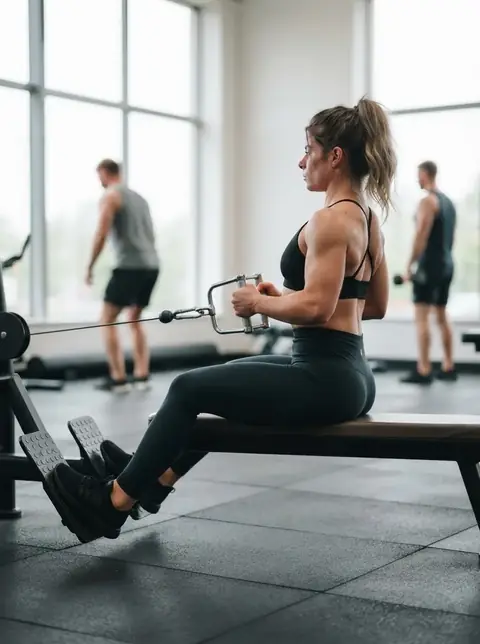


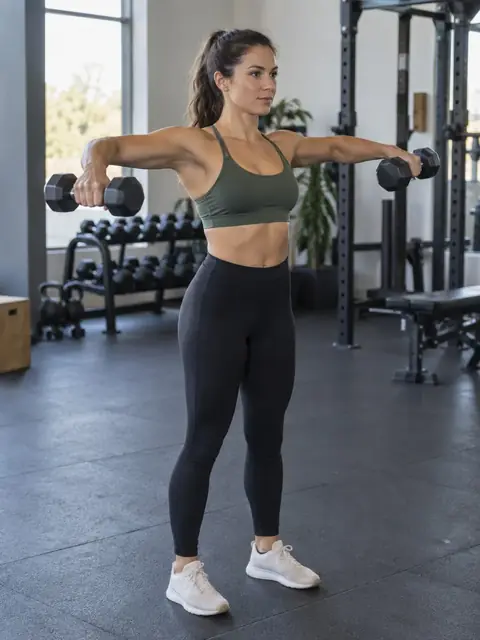
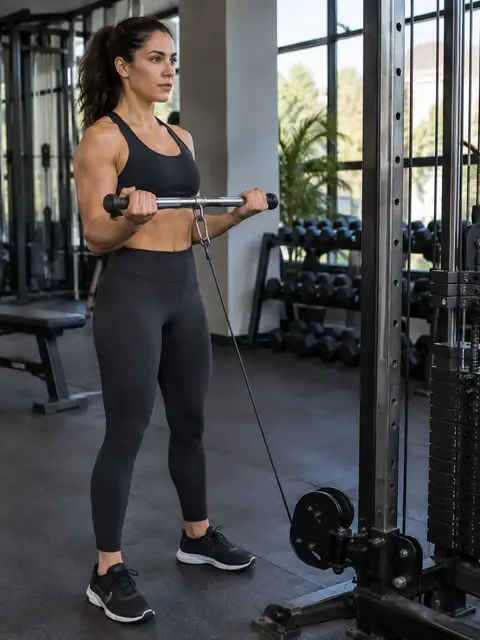

That is 6 push sets, 6 pull sets and 6 direct sets for shoulders and arms. The curl and the triceps exercise go in a superset. If you are short on time, also pair each press with the pull that follows it: a push and pull superset saves time without losing volume or results, although it feels harder (Zhang et al., 2025).
Dumbbell upper body workout
With dumbbells and a bench you can build the same idea. Since there is no pulldown, the dumbbell pullover covers the top to bottom pull. This version already uses supersets: the first exercise of each pair has no rest and the second one has the rest for the round.
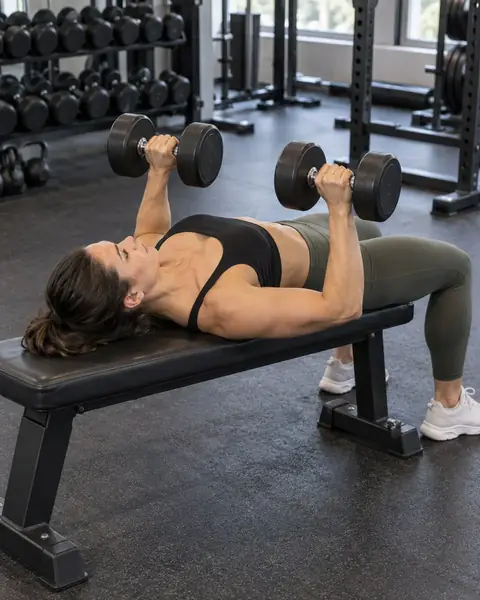
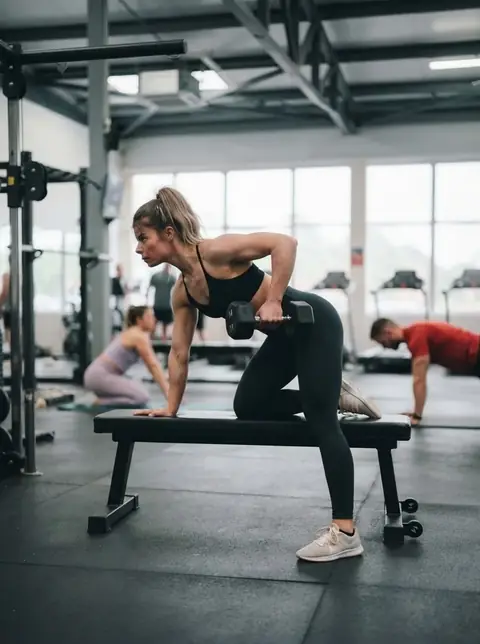
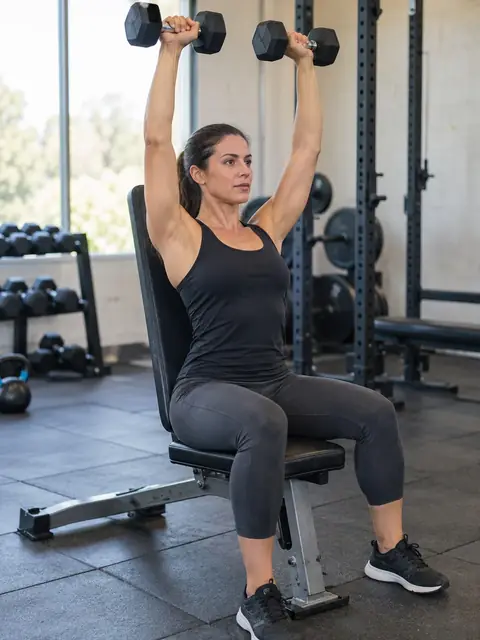
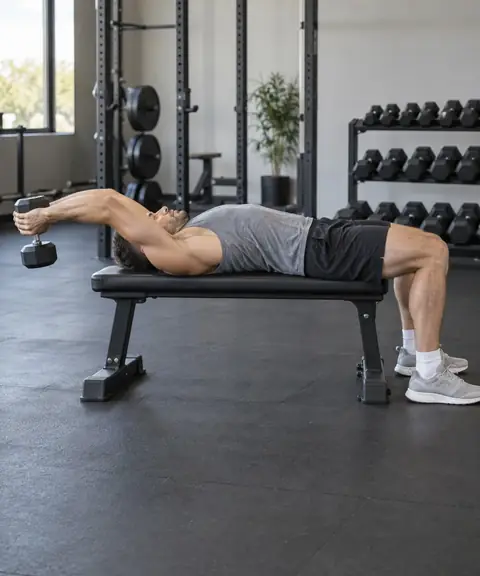
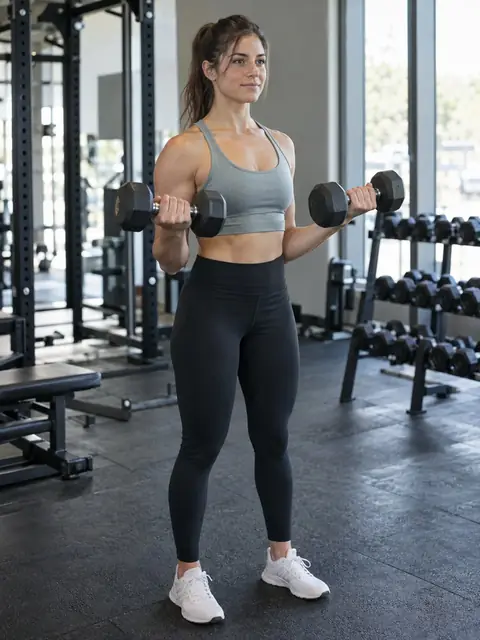

That is 6 push sets, 6 pull sets and 4 direct sets for arms. If your bench has no backrest, do the standing dumbbell shoulder press instead.
Upper body workout at home, without machines
You can build muscle without weights if each set ends close to failure, because muscle grows similarly with light or heavy loads when the sets are hard (Schoenfeld et al., 2017). Push ups cover pushing and a resistance band covers pulling, which is the hardest part to train at home. You need a band and a sturdy point to hook it to, like a door.

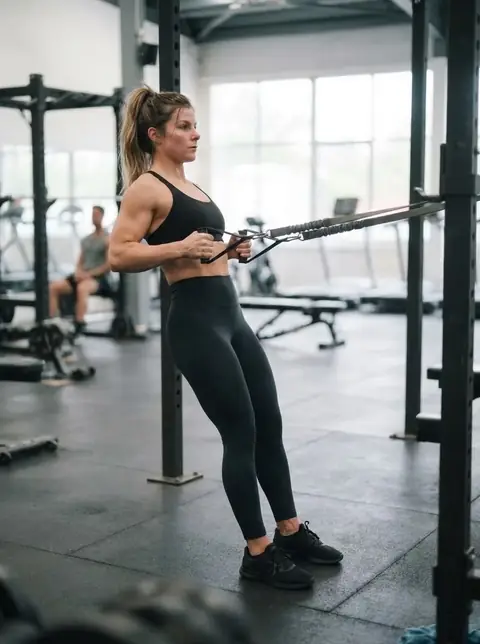
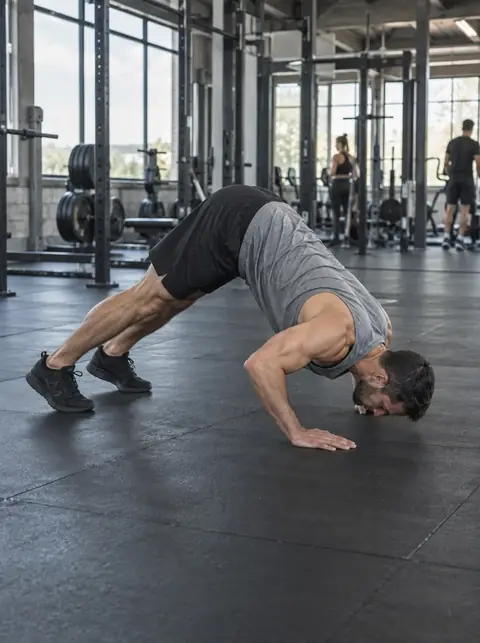
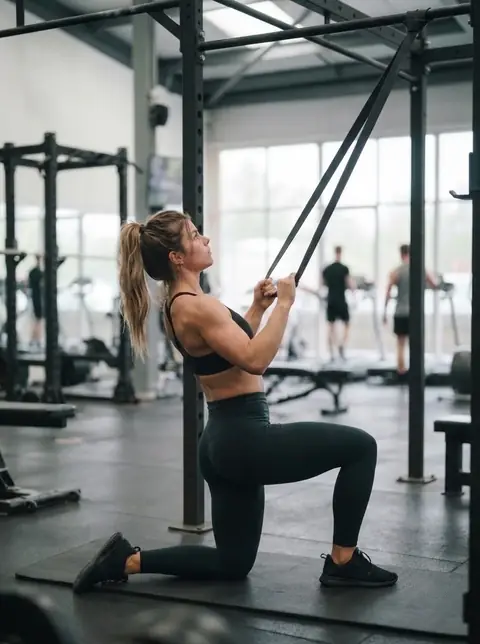


Still struggling with push ups? Start with the incline push up or the push up on knees and move to the regular one when you reach 15 reps. If you have a bar, swap the loop band lat pulldown for the loop band pull up.
How many upper body sets to do per week
To build muscle, what matters most is how many hard sets each muscle does per week (Schoenfeld, Ogborn and Krieger, 2017). The ACSM links the greatest hypertrophy to 10 or more sets per muscle per week and sees gains level off around 18 to 20 (Currier et al., 2026). Count muscle by muscle, not the total for the day. When you are starting out you do not need to reach 10: fewer sets also bring progress (Currier et al., 2023).
| Level | Sets for each | Upper body days | How to split them |
|---|---|---|---|
| Beginner | Fewer than 10 | 1 or 2 | One push, one pull and a few arm sets |
| Intermediate | 10 to 16 | 2 | 5 to 8 chest and back sets per session |
| Advanced | Up to 20 | 2 or 3 | A third day if they do not fit with good form |
The gym session, done twice a week, gives you 12 chest sets and 12 back sets. Shoulders, biceps and triceps get 4 direct sets each, plus the work from presses and rows. If you want more arm work, add an arm workout on another day.
How it fits into an upper/lower split
Upper body is usually half of an upper/lower split: two upper days and two lower days, alternating. Each muscle is trained twice a week, and since each session works half of your muscles, there are more sets per area than in a full body session.
| Day | Session | What it trains |
|---|---|---|
| Monday and Thursday | Upper body | Chest, back, shoulders and arms |
| Tuesday and Friday | Lower body | Quads, hamstrings, glutes and calves |
| Wednesday, Saturday and Sunday | Rest | Nothing |
With the same weekly volume, results are similar to other ways of training. In a trial with women who had no previous experience, 4 upper/lower sessions gave the same strength and muscle gains as 2 full body sessions with the same weekly sets (Pedersen et al., 2022), and a meta-analysis of 14 studies on splits in general reaches the same conclusion (Ramos-Campo et al., 2024). For the other half of the week, see the lower body workout.
The second day does not have to match the first. Many programs repeat the main lifts in another rep range, for example 6 to 8 reps one day and 10 to 12 the other, and change the accessories. Changing exercises at random every session, on the other hand, did not build more muscle (Baz-Valle et al., 2019).
Common upper body training mistakes
- Doing more pushing than pulling. A bench press, an incline press and a shoulder press with no row in sight is the typical case. Count your sets and keep pull sets level with push sets.
- Cramming in too many exercises. You cannot do ten upper body exercises well in an hour. Prioritize one heavy push and one heavy pull, and add shoulders and arms with a few sets or in supersets.
- Leaving your back for last. Whatever comes last gets done with less energy. Alternate push and pull instead of finishing all your chest work before starting your back.
- Going to failure on every set. Reaching failure does not build more muscle than stopping close to it (Refalo et al., 2023). Leave 1 or 2 reps in reserve on most sets.
- Resting too little. Resting more than 60 seconds has a small benefit, and beyond 90 it barely changes (Singer et al., 2024). On heavy main lifts, if you are after strength, more than 2 minutes works better in trained people (Grgic et al., 2018).
How to progress on your upper body workout
- Log every set. Weight and reps for each exercise. Without that number you do not know what to beat next session.
- Pick a press and a row as your benchmark. They come first and show best whether you are improving.
- Add reps first. Adding reps or adding load work similarly (Plotkin et al., 2022). When you reach the top of the range on every set, for example 12 reps, raise the weight by the smallest step you can.
- Check the big picture. If you stall for several sessions in a row, look at sleep and food before adding sets.
The full rule is in the progressive overload guide, the ranges are in sets and reps for hypertrophy, and you can estimate your press and row max with the 1RM calculator.
Questions
What muscles does an upper body workout train?
Chest, back, shoulders, biceps and triceps, and your forearms along the way. Abs usually go separately, at the end of any session: there is a session in the ab workout.
How many times a week should I train upper body?
Twice is the usual choice in an upper/lower split. With the same weekly volume, once or twice gives similar hypertrophy (Schoenfeld, Grgic and Krieger, 2019), so choose based on your days.
How many exercises should it have?
6 to 7 is enough: 2 push, 2 pull and 2 or 3 for shoulders and arms. More than that tends to stretch the session without the last ones getting done well.
Is upper/lower or push pull legs better?
With the same volume, splitting your body one way or another gives similar results (Ramos-Campo et al., 2024). Upper/lower fits 4 days well, and a push pull legs routine fits 3 or 6.
Can you train upper body at home?
Yes. Push ups cover pushing and a resistance band covers pulling, if each set ends close to failure and you keep making them harder.
Sources
- Schoenfeld BJ, Ogborn D, Krieger JW. Dose-response relationship between weekly resistance training volume and increases in muscle mass: a systematic review and meta-analysis. J Sports Sci. 2017. doi:10.1080/02640414.2016.1210197
- Schoenfeld BJ, Grgic J, Ogborn D, Krieger JW. Strength and hypertrophy adaptations between low- vs. high-load resistance training: a systematic review and meta-analysis. J Strength Cond Res. 2017. doi:10.1519/JSC.0000000000002200
- Currier BS, D'Souza AC, Singh MAF, et al. American College of Sports Medicine Position Stand. Resistance training prescription for muscle function, hypertrophy, and physical performance in healthy adults: an overview of reviews. Med Sci Sports Exerc. 2026. doi:10.1249/MSS.0000000000003897
- Currier BS, Mcleod JC, Banfield L, et al. Resistance training prescription for muscle strength and hypertrophy in healthy adults: a systematic review and Bayesian network meta-analysis. Br J Sports Med. 2023. doi:10.1136/bjsports-2023-106807
- Schoenfeld BJ, Grgic J, Krieger J. How many times per week should a muscle be trained to maximize muscle hypertrophy? A systematic review and meta-analysis of studies examining the effects of resistance training frequency. J Sports Sci. 2019. doi:10.1080/02640414.2018.1555906
- Nunes JP, Grgic J, Cunha PM, et al. What influence does resistance exercise order have on muscular strength gains and muscle hypertrophy? A systematic review and meta-analysis. Eur J Sport Sci. 2021. doi:10.1080/17461391.2020.1733672
- Zhang X, Weakley J, Li H, Li Z, García-Ramos A. Superset versus traditional resistance training prescriptions: a systematic review and meta-analysis exploring acute and chronic effects on mechanical, metabolic, and perceptual variables. Sports Med. 2025. doi:10.1007/s40279-025-02176-8
- Pedersen H, Fimland MS, Schoenfeld BJ, et al. A randomized trial on the efficacy of split-body versus full-body resistance training in non-resistance trained women. BMC Sports Sci Med Rehabil. 2022. doi:10.1186/s13102-022-00481-7
- Ramos-Campo DJ, Benito-Peinado PJ, Andreu-Caravaca L, Rojo-Tirado MA, Rubio-Arias JÁ. Efficacy of split versus full-body resistance training on strength and muscle growth: a systematic review with meta-analysis. J Strength Cond Res. 2024. doi:10.1519/JSC.0000000000004774
- Baz-Valle E, Schoenfeld BJ, Torres-Unda J, Santos-Concejero J, Balsalobre-Fernández C. The effects of exercise variation in muscle thickness, maximal strength and motivation in resistance trained men. PLoS One. 2019. doi:10.1371/journal.pone.0226989
- Refalo MC, Helms ER, Trexler ET, Hamilton DL, Fyfe JJ. Influence of resistance training proximity-to-failure on skeletal muscle hypertrophy: a systematic review with meta-analysis. Sports Med. 2023. doi:10.1007/s40279-022-01784-y
- Singer A, Wolf M, Generoso L, et al. Give it a rest: a systematic review with Bayesian meta-analysis on the effect of inter-set rest interval duration on muscle hypertrophy. Front Sports Act Living. 2024. doi:10.3389/fspor.2024.1429789
- Grgic J, Schoenfeld BJ, Skrepnik M, Davies TB, Mikulic P. Effects of rest interval duration in resistance training on measures of muscular strength: a systematic review. Sports Med. 2018. doi:10.1007/s40279-017-0788-x
- Plotkin D, Coleman M, Van Every D, et al. Progressive overload without progressing load? The effects of load or repetition progression on muscular adaptations. PeerJ. 2022. doi:10.7717/peerj.14142
This guide is for information only and does not replace advice from a health professional.