The best arm exercises
Your biceps bend your elbow and your triceps straighten it. That is why almost every arm workout comes down to curls and extensions, and what changes is your arm position and your grip. The triceps is the largest muscle of the upper arm, so it deserves as many sets as the biceps. Your forearms work every time you hold the weight.
- Barbell curl. The barbell curl is the curl where you move the most weight, which makes it useful for tracking your progress.
- Incline curl. In the incline dumbbell curl, your arm stays behind your torso and your biceps starts stretched.
- Hammer curl. The hammer curl uses a neutral grip and adds more forearm work.
- Overhead extension. Triceps extensions with your arm overhead, like the cable overhead tricep extension, grew the triceps about 1.4 times more than the same extension with your arm at your side (Maeo et al., 2023).
- Tricep pushdown. The tricep pushdown is simple to learn and easy to load little by little.
- Close grip press and dips. The close grip bench press and the tricep dip let you move more weight, and they also work your chest and shoulders.
You have every option among the biceps, triceps and forearm exercises, each with a photo and step-by-step instructions. To focus on one, see the biceps workout and the triceps workout.
Why train biceps and triceps in supersets
A superset joins two exercises with no break: you do a set of the first, move to the second and only then rest. Alternating an exercise for one muscle with one for the opposite muscle shortens the session without losing volume or results, although it feels harder (Zhang et al., 2025). Biceps and triceps do opposite movements at the elbow, so while you do the second exercise the muscle from the first one rests.
- Pick a pair. A curl and an extension, in the same spot if you can, so you do not lose time between them.
- Do both sets in a row. One set of curls and, with no break, one set of extensions. That is one round.
- Rest when you finish the pair. Resting more than 60 seconds has a small benefit, and beyond 90 it barely changes (Singer et al., 2024). That is why the sessions below say 90 seconds.
- If you prefer, keep them apart. Do the same exercises one after the other, with normal rest between sets. It will just take longer.
Arm workout at the gym
Each pair joins a biceps exercise with a triceps exercise. Start with the ones you most want to improve, because the exercise done first gains the most strength (Nunes et al., 2021). The first exercise of each pair has no rest, and the second one has the rest for the round.
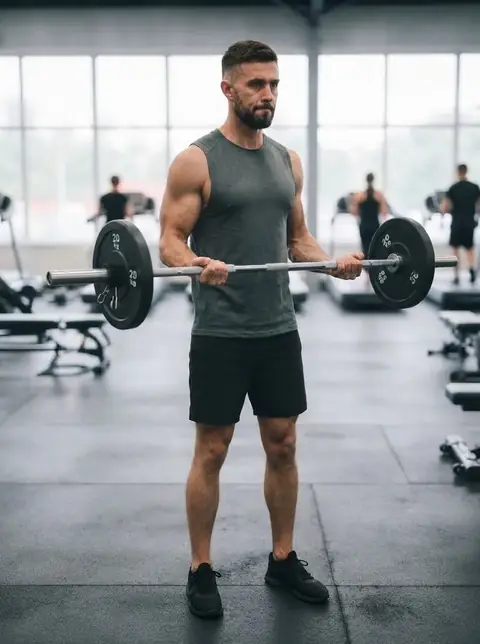
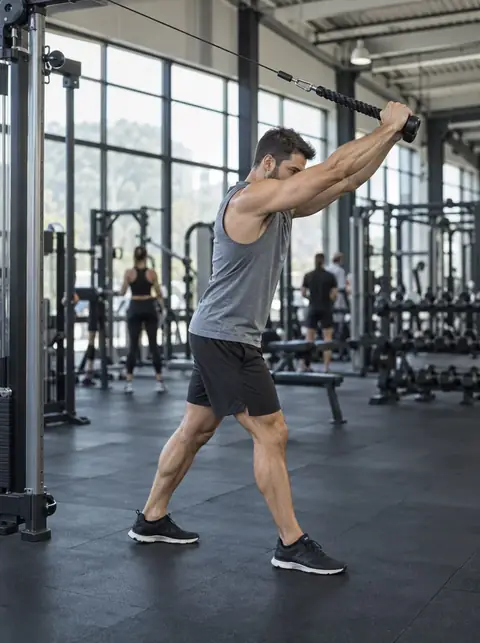
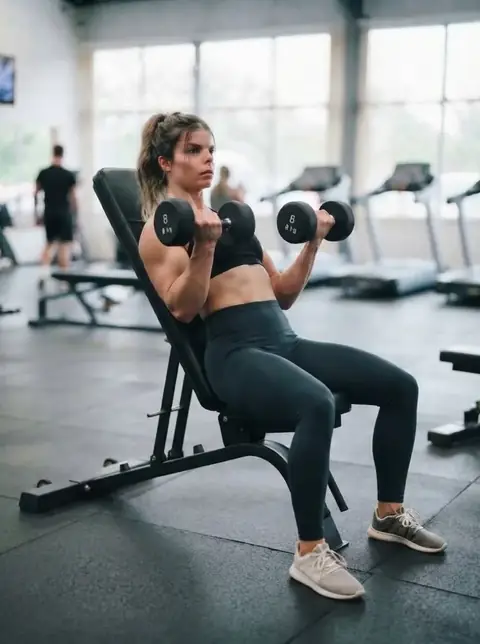
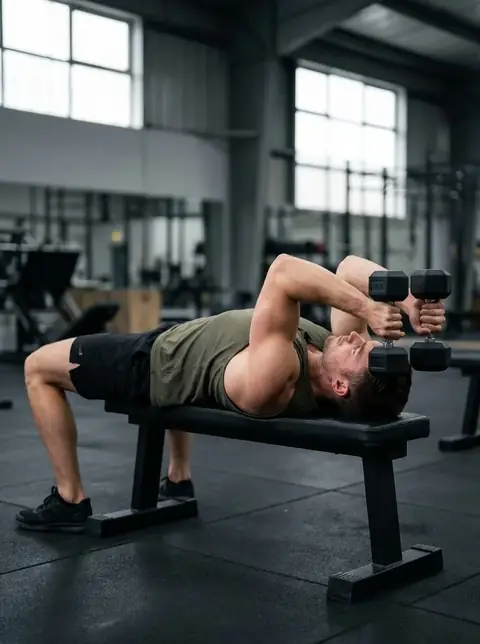
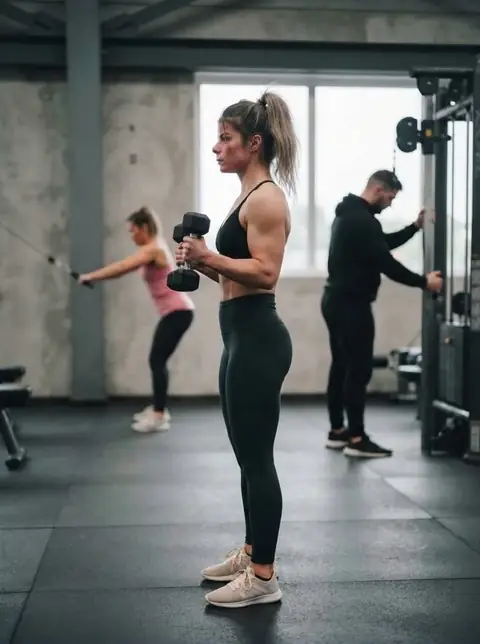
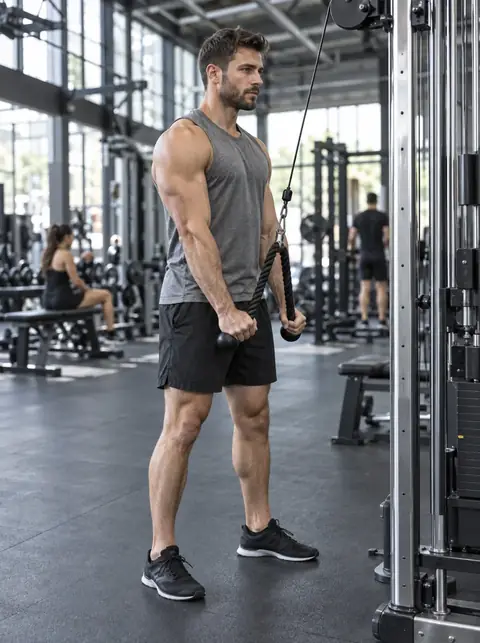
That is 8 sets for biceps and 8 for triceps. If you do it twice a week, you reach 16 of each. If you already do plenty of presses and rows, once a week may be enough, because those exercises also work your arms.
Dumbbell arm workout
Dumbbells are enough to train your arms well. Each arm works on its own, which helps you notice if one side falls behind. With a bench you can also do the dumbbell tricep extension, with your arm overhead.
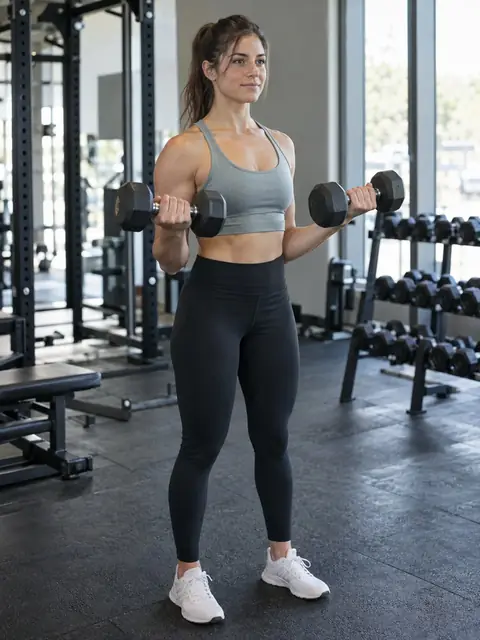
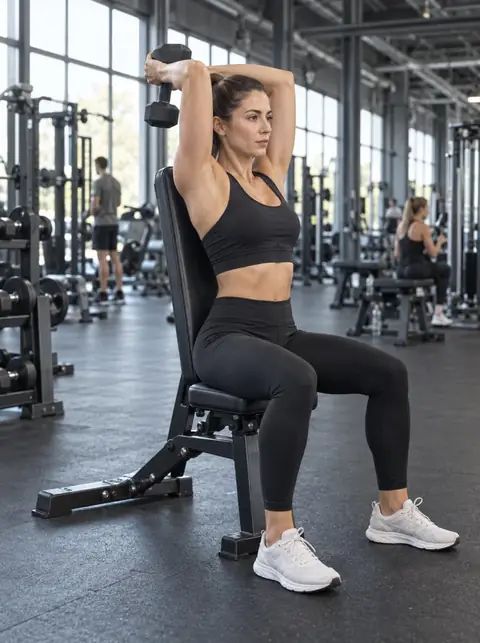
That is 6 sets for biceps and 6 for triceps. If you do it twice a week, you reach 12 of each. When the dumbbells you have stop being enough, add reps or lower more slowly before changing the weight.
Arm workout at home, without machines
You can build muscle without weights if each set ends close to failure, because muscle grows similarly with light or heavy loads when the sets are hard (Schoenfeld et al., 2017). You only need a resistance band. The loop band row is not a pure arm exercise, but it bends your elbow and adds biceps work, and the close grip push up loads your triceps with your own bodyweight.
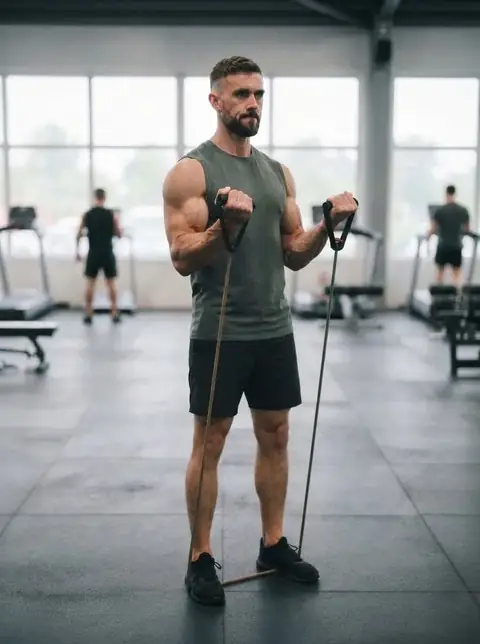
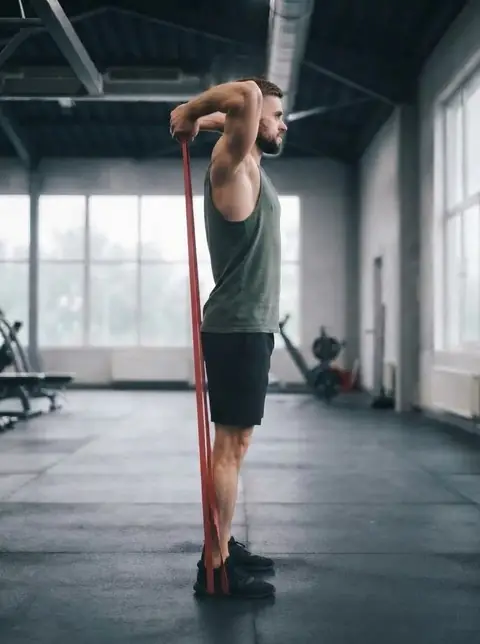
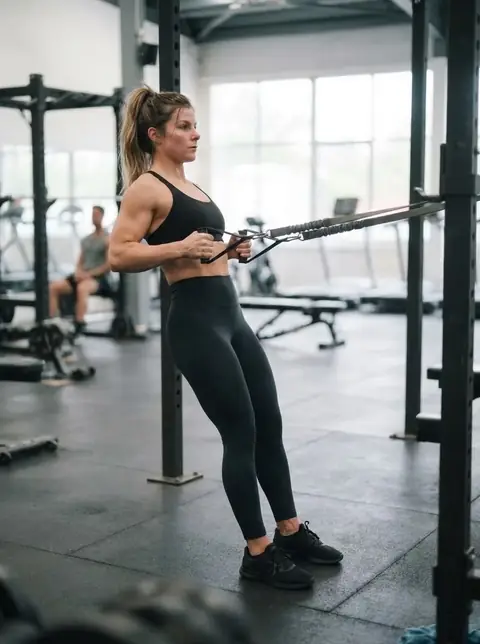
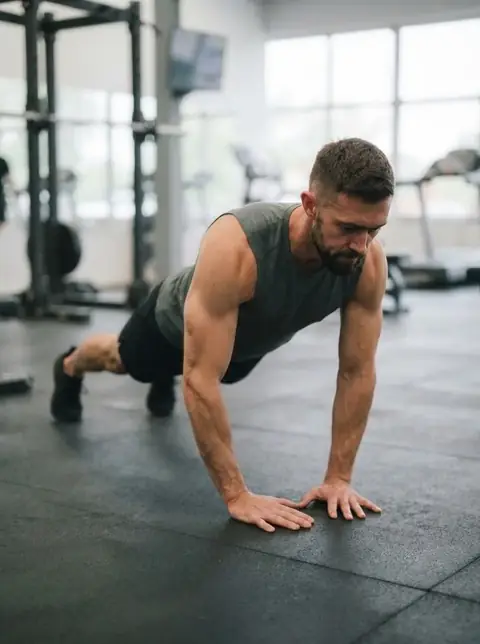
Still struggling with the close grip push up? Start with the incline push up or the push up on knees, with your hands closer together. When it gets easy, move to the diamond push up.
How many arm sets to do per week
To build muscle, what matters most is how many hard sets each muscle does per week (Schoenfeld, Ogborn and Krieger, 2017). The ACSM links the greatest hypertrophy to 10 or more sets per muscle per week and sees gains level off around 18 to 20 (Currier et al., 2026). Biceps and triceps count separately. A review saw no difference in the biceps between 12 to 20 weekly sets and more than 20, although the triceps did grow more with high volume (Baz-Valle et al., 2022). When you are starting out you do not need to reach 10: fewer sets also bring progress (Currier et al., 2023).
| Level | Sets for each | Sessions | How to split them |
|---|---|---|---|
| Beginner | Fewer than 10 | 1 or 2 | One curl and one extension per session |
| Intermediate | 10 to 14 | 2 | 5 to 7 sets of each per session |
| Advanced | Up to 20 | 2 or 3 | More than 2 sessions if they do not fit with good form |
Training a muscle once or twice a week gives similar hypertrophy when the volume is the same (Schoenfeld, Grgic and Krieger, 2019), so pick what suits you. You can also pair each one with the muscle that already uses it, in a back and biceps workout or a chest and triceps workout, or add them at the end of an upper body workout.
Common arm training mistakes
- Training only biceps. The triceps is the largest muscle of the upper arm. Give it as many sets as the biceps.
- Doing every extension with your arm at your side. Include at least one with your arm overhead, for the reason above (Maeo et al., 2023).
- Swinging your body on curls. You move more weight, but your back and legs take the work. Lower the weight until the movement comes from your elbow.
- Going to failure on every set. Reaching failure does not build more muscle than stopping close to it (Refalo et al., 2023). Leave 1 or 2 reps in reserve on most sets.
- Cutting the rest between rounds. Supersets feel harder (Zhang et al., 2025), and resting less than 60 seconds tends to cut your volume (Singer et al., 2024). If the second round is much worse than the first, rest longer.
- Changing exercises every week. Rotating at random or very often can hurt (Kassiano et al., 2022). Repeating the same session lets you see whether you are improving.
How to progress on your arm workout
- Log every set. Weight and reps for each exercise. Without that number you do not know what to beat next session.
- Add reps first. Adding reps or adding load work similarly (Plotkin et al., 2022). When you reach the top of the range on every set, for example 12 reps, raise the weight by the smallest step you can.
- Keep your form. If going up means swinging or moving your elbows, it is not time yet.
- Check the big picture. If you stall for several sessions in a row, look at sleep and food before adding sets.
The full rule is in the progressive overload guide. For heavy exercises like the close grip bench press, you can estimate your max with the 1RM calculator.
Questions
How many arm exercises should I do per session?
4 to 6, half for biceps and half for triceps. With 2 pairs and 3 sets on each exercise you already get 6 sets per muscle, which is a good starting point.
How many times a week should I train arms?
Once or twice is the most convenient. With the same weekly volume the results are similar, so choose based on how many days you can train.
Should I train biceps and triceps on the same day?
Yes, and it saves time. Alternating them in supersets shortens the session without losing volume or results, although it feels harder (Zhang et al., 2025).
Can you train arms without weights?
Yes. The close grip push up covers your triceps and the loop band bicep curl covers your biceps, if each set ends close to failure and you keep making them harder.
Do I need to train forearms separately?
Not to start with, because they already work when you hold the weight. If you want more, add a reverse barbell curl or a palms up barbell wrist curl at the end.
Sources
- Schoenfeld BJ, Ogborn D, Krieger JW. Dose-response relationship between weekly resistance training volume and increases in muscle mass: a systematic review and meta-analysis. J Sports Sci. 2017. doi:10.1080/02640414.2016.1210197
- Schoenfeld BJ, Grgic J, Ogborn D, Krieger JW. Strength and hypertrophy adaptations between low- vs. high-load resistance training: a systematic review and meta-analysis. J Strength Cond Res. 2017. doi:10.1519/JSC.0000000000002200
- Currier BS, D'Souza AC, Singh MAF, et al. American College of Sports Medicine Position Stand. Resistance training prescription for muscle function, hypertrophy, and physical performance in healthy adults: an overview of reviews. Med Sci Sports Exerc. 2026. doi:10.1249/MSS.0000000000003897
- Currier BS, Mcleod JC, Banfield L, et al. Resistance training prescription for muscle strength and hypertrophy in healthy adults: a systematic review and Bayesian network meta-analysis. Br J Sports Med. 2023. doi:10.1136/bjsports-2023-106807
- Baz-Valle E, Balsalobre-Fernández C, Alix-Fages C, Santos-Concejero J. A systematic review of the effects of different resistance training volumes on muscle hypertrophy. J Hum Kinet. 2022. doi:10.2478/hukin-2022-0017
- Schoenfeld BJ, Grgic J, Krieger J. How many times per week should a muscle be trained to maximize muscle hypertrophy? A systematic review and meta-analysis of studies examining the effects of resistance training frequency. J Sports Sci. 2019. doi:10.1080/02640414.2018.1555906
- Maeo S, Wu Y, Huang M, et al. Triceps brachii hypertrophy is substantially greater after elbow extension training performed in the overhead versus neutral arm position. Eur J Sport Sci. 2023. doi:10.1080/17461391.2022.2100279
- Zhang X, Weakley J, Li H, Li Z, García-Ramos A. Superset versus traditional resistance training prescriptions: a systematic review and meta-analysis exploring acute and chronic effects on mechanical, metabolic, and perceptual variables. Sports Med. 2025. doi:10.1007/s40279-025-02176-8
- Nunes JP, Grgic J, Cunha PM, et al. What influence does resistance exercise order have on muscular strength gains and muscle hypertrophy? A systematic review and meta-analysis. Eur J Sport Sci. 2021. doi:10.1080/17461391.2020.1733672
- Refalo MC, Helms ER, Trexler ET, Hamilton DL, Fyfe JJ. Influence of resistance training proximity-to-failure on skeletal muscle hypertrophy: a systematic review with meta-analysis. Sports Med. 2023. doi:10.1007/s40279-022-01784-y
- Singer A, Wolf M, Generoso L, et al. Give it a rest: a systematic review with Bayesian meta-analysis on the effect of inter-set rest interval duration on muscle hypertrophy. Front Sports Act Living. 2024. doi:10.3389/fspor.2024.1429789
- Kassiano W, Nunes JP, Costa B, Ribeiro AS, Schoenfeld BJ, Cyrino ES. Does varying resistance exercises promote superior muscle hypertrophy and strength gains? A systematic review. J Strength Cond Res. 2022. doi:10.1519/JSC.0000000000004258
- Plotkin D, Coleman M, Van Every D, et al. Progressive overload without progressing load? The effects of load or repetition progression on muscular adaptations. PeerJ. 2022. doi:10.7717/peerj.14142
This guide is for information only and does not replace advice from a health professional.