The best cable shoulder exercises
Your shoulder has three parts. The front moves your arm forward, the side lifts it away from your body, and the rear pulls it back. Cables hit all three well, and switching exercises is as quick as changing the handle or the pulley height.
- Cable lateral raise. The best one for the side delt, the part that makes your shoulders look wider. Done one arm at a time from the low pulley. See the cable lateral raise.
- Behind-the-back lateral raise. The same raise with the cable running behind your body. It changes the angle the movement starts from. See the behind-the-back cable lateral raise.
- Face pull. You pull a rope from the high pulley toward your face. It works the rear delt and upper back. See the cable face pull.
- High cable reverse fly. With the cables crossed, you open your arms back. The other option for the rear delt, which presses barely touch. See the cross-cable rear delt fly.
- Cable upright row. A bar from the low pulley that you pull up close to your body, elbows out. It works the shoulders with help from the upper back and biceps. See the cable upright row.
- Rope front raise. For the front delt when the routine has no press. See the rope front raise.
Most gyms don't have a cable shoulder press, so the second routine uses the machine shoulder press. You'll find every exercise, with barbells, dumbbells or machines, in the list of shoulder exercises.
Cables-only shoulder workout
Everything at one cable station, no switching machines. Start with the upright row, the exercise that moves the most weight, because whatever comes first gains the most strength (Nunes et al., 2021). The raises and the fly come next and need much less weight.
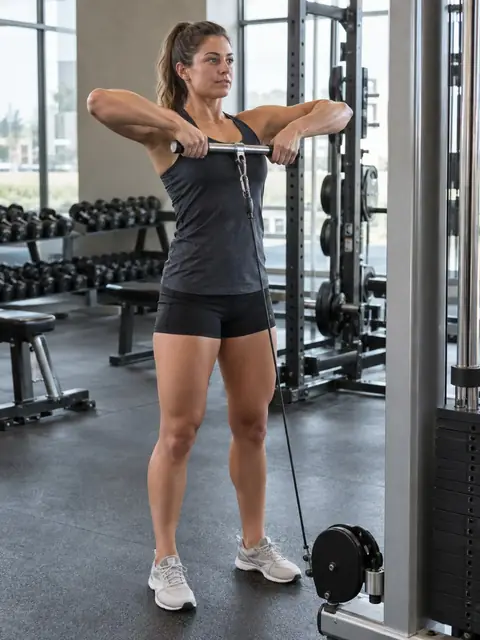
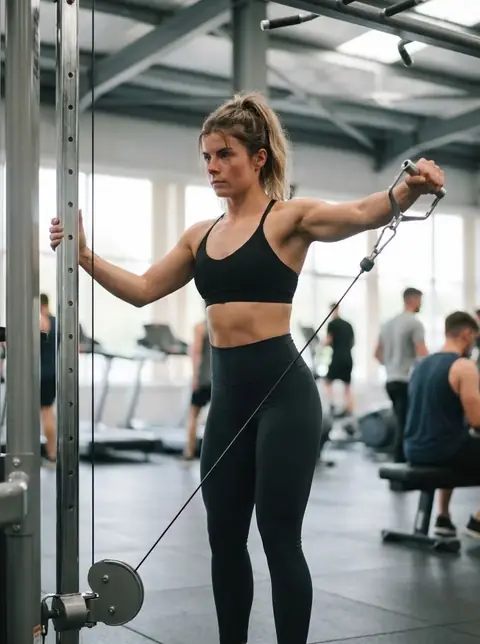
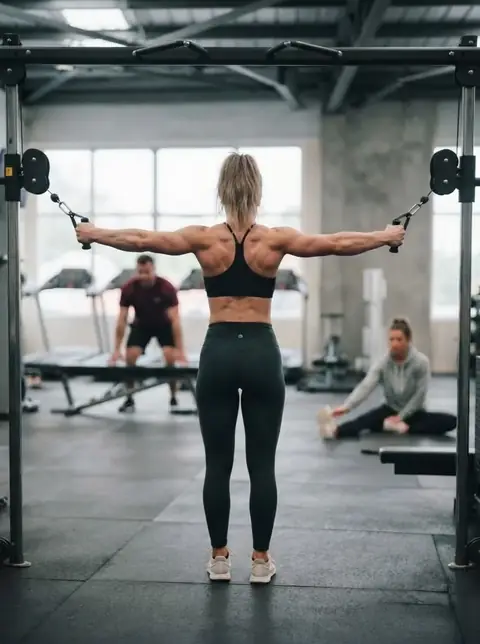
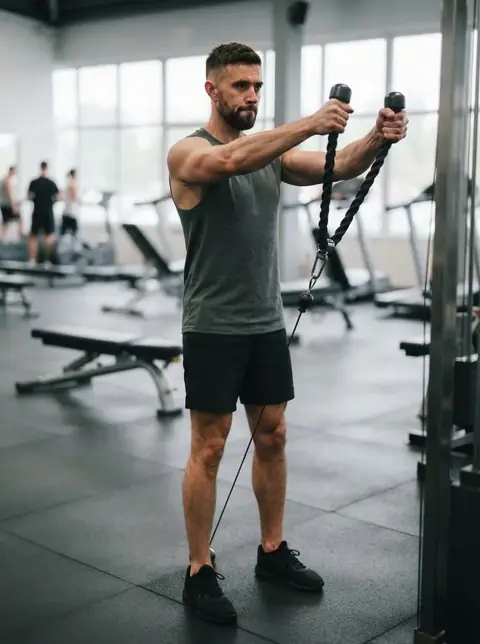
Of the 12 sets, 7 go to the side delt (row and raise), 3 to the rear and 2 to the front, which gets no press work here. On lateral raises, do all your sets with one arm and then the other, or alternate arms without a break and rest after both.
Cable and machine shoulder workout, with a press
If you want a press for the front delt and triceps, start with the machine and then move to the cables. This version has two different lateral raises and the face pull for the rear delt.
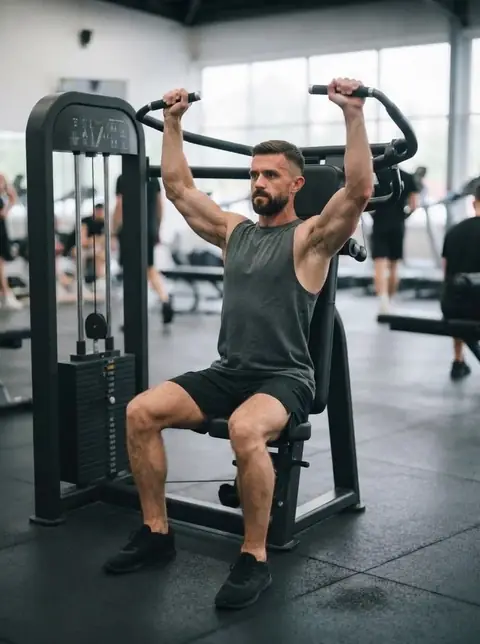
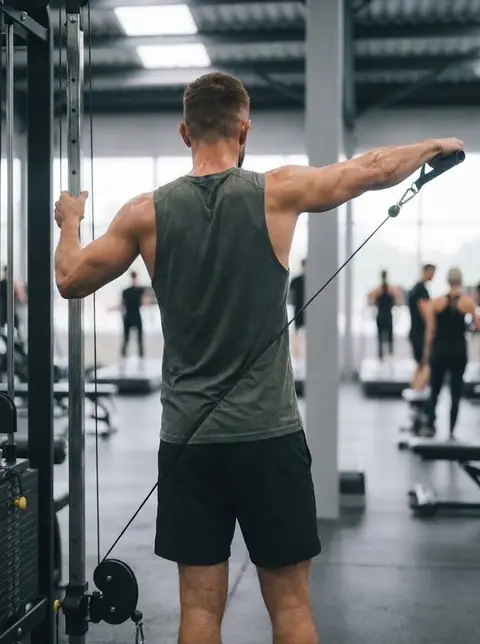
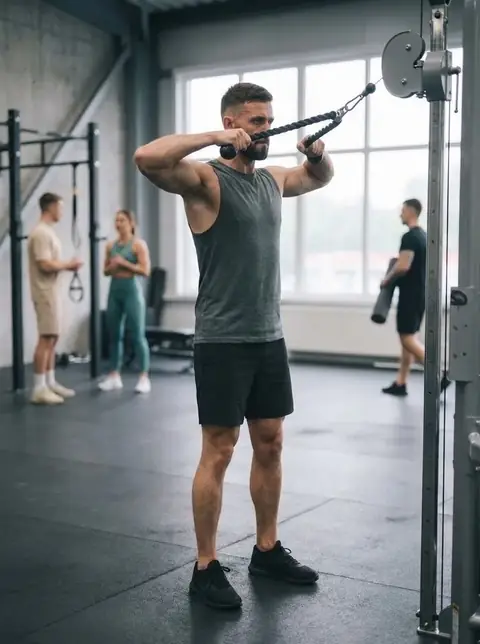
Use it for a shoulder day or at the end of a push day when chest work was light. For a session with barbells and dumbbells, see the shoulder workout, and for one without cables, the dumbbell shoulder workout.
Cable shoulder workout for beginners
If you're just starting, three exercises with two sets each is enough. Fewer sets still build muscle (Currier et al., 2023), and the cables and machine guide the movement while you learn the technique.
Start the lateral raise at the lowest plate on the stack: almost everyone underestimates it. It also works as a short block at the end of an upper body session, like the one in the upper body workout.
How many shoulder sets to do and what weight to use on cables
For muscle growth, what matters most is how many hard sets each muscle gets per week (Schoenfeld, Ogborn and Krieger, 2017). The ACSM links the most hypertrophy to 10 or more sets per muscle per week and sees gains level off around 18 to 20 (Currier et al., 2026). Training a muscle once or twice a week gives similar results when volume is the same (Schoenfeld, Grgic and Krieger, 2019).
| Level | Direct sets per week | How to get there |
|---|---|---|
| Beginner | 6 to 12 | The beginner routine, 1 or 2 times a week |
| Intermediate | 11 to 12 | The cables-only or the cable and machine routine, once a week |
| Advanced | 17 to 18 | One full routine plus the beginner routine on another day |
Are cables better than dumbbells? In a study of 24 trained people, each did cable lateral raises with one arm and dumbbell raises with the other, 10 sets a week of 12 to 16 reps to failure. In 8 weeks, the side delt grew 3% to 5% with both, with no difference between them (Larsen et al., 2025). Pick whichever feels better. Since the weight is light, keep in mind that muscle grows about the same with light or heavy loads if each set ends close to failure (Schoenfeld et al., 2017).
Common mistakes and how to progress on cables
- Cutting the range of motion short. On average, a full range of motion builds slightly more muscle than a partial one, though the difference is small (Wolf et al., 2023). Bring your arm all the way down to your side on every rep.
- Using your body to move the cable. If you lean or jerk the cable, your shoulder does less. Drop a plate and lift with control.
- Going to failure on every set. Training to failure doesn't build more muscle than stopping close to it (Refalo et al., 2023). Leave 1 to 3 reps in reserve, especially on the press and the row.
- Resting too little. Resting more than 60 seconds has a small benefit, and beyond 90 it barely changes (Singer et al., 2024). That's why the raises get 90 seconds here.
- Log every set. Weight and reps for each exercise, plus the pulley height, so you can repeat the same angle next time.
- Add reps first. Once you hit the top of the range on every set, say 20 on the lateral raise, move to the next plate.
- If the plate jump is big, keep adding reps. One more plate on a lateral raise can be a lot. Adding load and adding reps gave similar results over 8 weeks in trained people (Plotkin et al., 2022).
- Keep your form. If you have to lean or shorten the range to get the weight up, it's not time yet.
The full rule is in the progressive overload guide, and you can estimate your machine press max with the 1RM calculator.
Questions
What is the best cable exercise for shoulders?
There isn't just one, because your shoulder has three parts. The lateral raise targets width, and the face pull or reverse fly targets the rear. A complete routine has at least one from each group.
Are cable lateral raises better than dumbbell lateral raises?
They give the same result. In an 8-week study of trained people, the shoulder grew the same with both (Larsen et al., 2025). Use whichever is available or feels better.
What height should the pulley be for lateral raises?
Low, roughly at hand height with your arm at your side. Note the height you use so you repeat the same angle every session.
How many sets of cable shoulder exercises per week?
Ten or more direct sets a week for most people. Beyond 18 to 20, gains level off (Currier et al., 2026).
Can you train shoulders with cables only?
Yes. The cables-only routine in this guide works all three parts of the shoulder with four exercises at the same station.
Sources
- Larsen S, Wolf M, Schoenfeld BJ, et al. Dumbbell versus cable lateral raises for lateral deltoid hypertrophy: an experimental study. Front Physiol. 2025;16:1611468. doi:10.3389/fphys.2025.1611468
- Wolf M, Androulakis-Korakakis P, Fisher J, Schoenfeld B, Steele J. Partial vs full range of motion resistance training: a systematic review and meta-analysis. Int J Strength Cond. 2023;3(1). doi:10.47206/ijsc.v3i1.182
- Schoenfeld BJ, Ogborn D, Krieger JW. Dose-response relationship between weekly resistance training volume and increases in muscle mass: a systematic review and meta-analysis. J Sports Sci. 2017. doi:10.1080/02640414.2016.1210197
- Currier BS, D'Souza AC, Singh MAF, et al. American College of Sports Medicine Position Stand. Resistance training prescription for muscle function, hypertrophy, and physical performance in healthy adults: an overview of reviews. Med Sci Sports Exerc. 2026. doi:10.1249/MSS.0000000000003897
- Currier BS, Mcleod JC, Banfield L, et al. Resistance training prescription for muscle strength and hypertrophy in healthy adults: a systematic review and Bayesian network meta-analysis. Br J Sports Med. 2023. doi:10.1136/bjsports-2023-106807
- Schoenfeld BJ, Grgic J, Ogborn D, Krieger JW. Strength and hypertrophy adaptations between low- vs. high-load resistance training: a systematic review and meta-analysis. J Strength Cond Res. 2017. doi:10.1519/JSC.0000000000002200
- Schoenfeld BJ, Grgic J, Krieger J. How many times per week should a muscle be trained to maximize muscle hypertrophy? A systematic review and meta-analysis of studies examining the effects of resistance training frequency. J Sports Sci. 2019. doi:10.1080/02640414.2018.1555906
- Refalo MC, Helms ER, Trexler ET, Hamilton DL, Fyfe JJ. Influence of resistance training proximity-to-failure on skeletal muscle hypertrophy: a systematic review with meta-analysis. Sports Med. 2023. doi:10.1007/s40279-022-01784-y
- Singer A, Wolf M, Generoso L, et al. Give it a rest: a systematic review with Bayesian meta-analysis on the effect of inter-set rest interval duration on muscle hypertrophy. Front Sports Act Living. 2024. doi:10.3389/fspor.2024.1429789
- Plotkin D, Coleman M, Van Every D, et al. Progressive overload without progressing load? The effects of load or repetition progression on muscular adaptations. PeerJ. 2022. doi:10.7717/peerj.14142
- Nunes JP, Grgic J, Cunha PM, et al. What influence does resistance exercise order have on muscular strength gains and muscle hypertrophy? A systematic review and meta-analysis. Eur J Sport Sci. 2021. doi:10.1080/17461391.2020.1733672
This guide is for information only and does not replace advice from a health professional.