What the upper chest is and which angle to use
The pectoralis major is one muscle with fibers running in several directions. The upper fibers start at the collarbone and move the arm forward and up. That part is called the upper chest, or clavicular head. You can't train it alone, but inclining the bench changes how hard it works.
| Bench angle | Upper chest |
|---|---|
| Decline (−15°) | 96% |
| Flat (0°) | 98% |
| Incline (30°) | 122.5% |
| Incline (45°) | 124% |
In that part of the lift, the 30° and 45° benches activated the upper chest more than the flat and decline benches. Looking at the whole lift, the gap gets smaller (Lauver et al., 2016). Two other studies point the same way: in 15 men, the upper chest worked harder at 44° than at 0° and 28° (Trebs et al., 2010), and in 30 trained adults it peaked with the bench at 30° (Rodríguez-Ridao et al., 2020).
More incline is not always better. The higher the bench, the more your shoulders work: the front delt peaked at 60° (Rodríguez-Ridao et al., 2020). And the muscle responds: in an 8-week trial with 47 untrained men, the upper chest grew 0.62 cm more with the incline press than with the flat press, and strength went up about the same in both (Chaves et al., 2020). A bench between 30° and 45° is the sweet spot.
The 6 best upper chest exercises
They all have one thing in common: your arms press or come together upward, along the line of the fibers that start at the collarbone.
- Barbell incline press. The foundation. It lets you move a lot of weight and track your progress week to week. See the barbell incline bench press.
- Dumbbell incline press. The same angle, with each arm working on its own and a bit more range at the bottom. See the dumbbell incline bench press.
- Machine incline press. The path is guided, so you can get close to failure without a spotter. See the machine incline chest press or the Smith machine version.
- Dumbbell incline fly. It brings your arms together with little help from the triceps. Use a weight you can lower under control. See the dumbbell incline fly.
- Low-to-high cable fly. With the pulleys low, you bring your hands together at chest height. It keeps tension through the whole range. See the low cable chest fly or the incline bench cable fly.
- Decline push-up. With your feet on a bench or chair and your hands on the floor. Your body ends up at the angle of an incline press. See the decline push-up.
For the rest of the muscle, see the full chest workout, the lower chest workout guide, and the list of chest exercises.
Upper chest workout at the gym
Start with the exercise you most want to improve, because the one you do first gains the most strength (Nunes et al., 2021). Here the barbell incline press opens, the machine follows, and the cables finish.
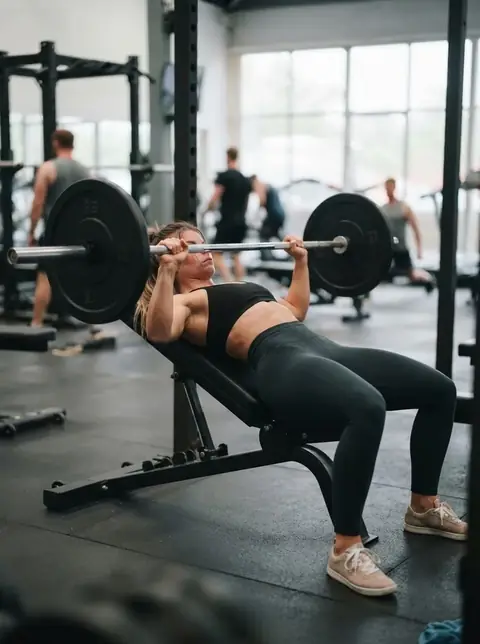
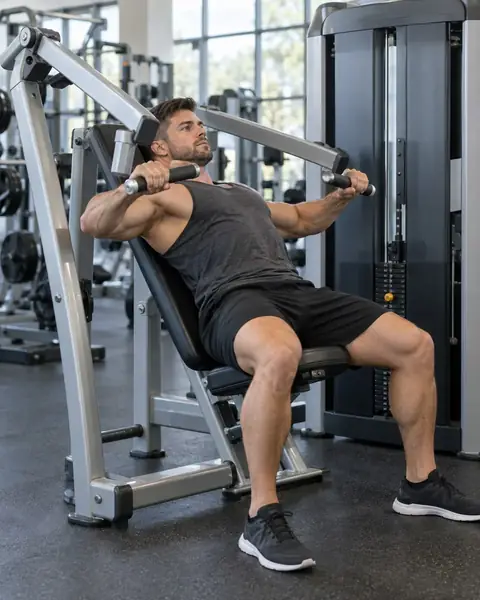
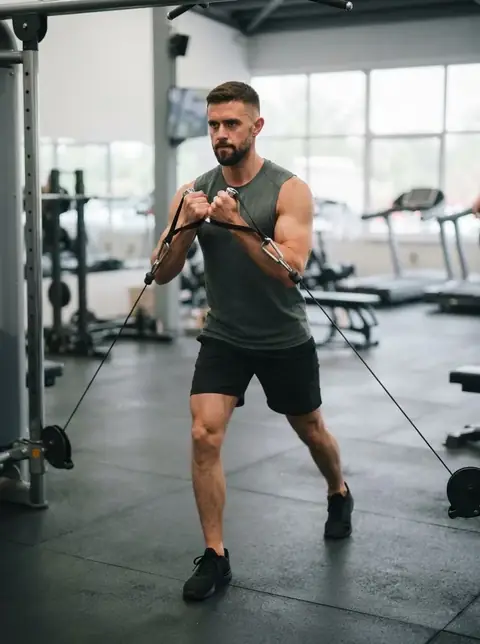
If the machine is taken, use the Smith machine incline press. On a full chest day, add a flat press: the lower chest works harder on a flat bench than on an incline (Trebs et al., 2010).
Upper chest workout with dumbbells
All you need is dumbbells and a bench that inclines. Set it between 30° and 45°: on many benches that is the second or third notch.
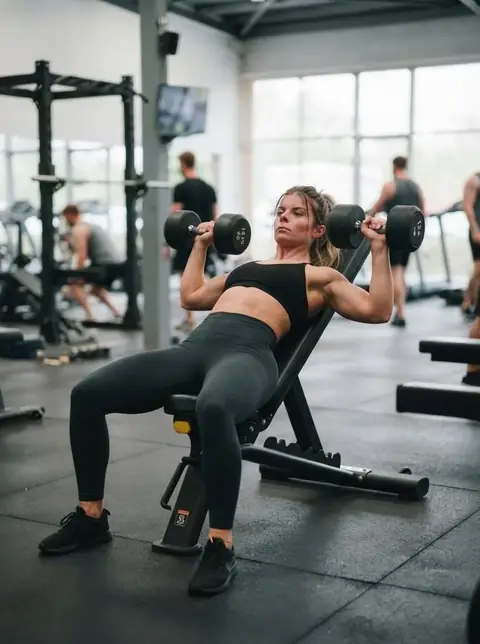
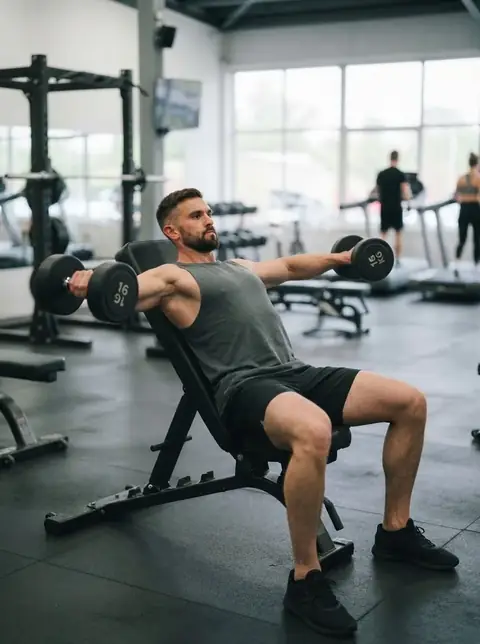
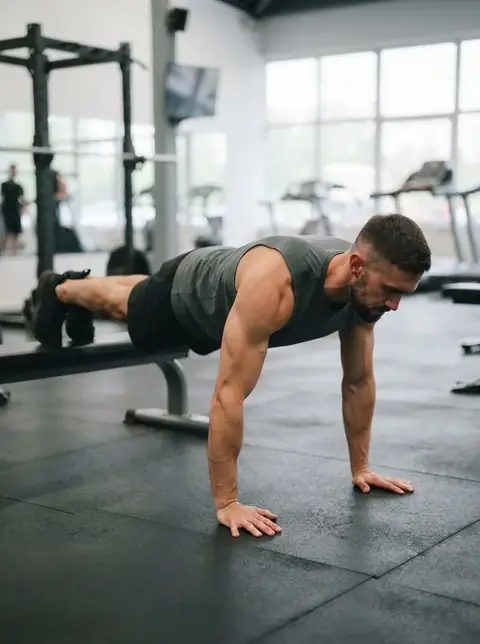
On the fly, lower until you feel the stretch in your chest, without forcing your shoulders. For more sessions with this gear, see the dumbbell chest workout guide.
Upper chest workout at home
Your body weight is enough. Over 8 weeks, push-ups built about as much chest muscle as the bench press with the same load (Kikuchi and Nakazato, 2017), and muscle grows with light or heavy loads as long as each set ends close to failure (Schoenfeld et al., 2017).
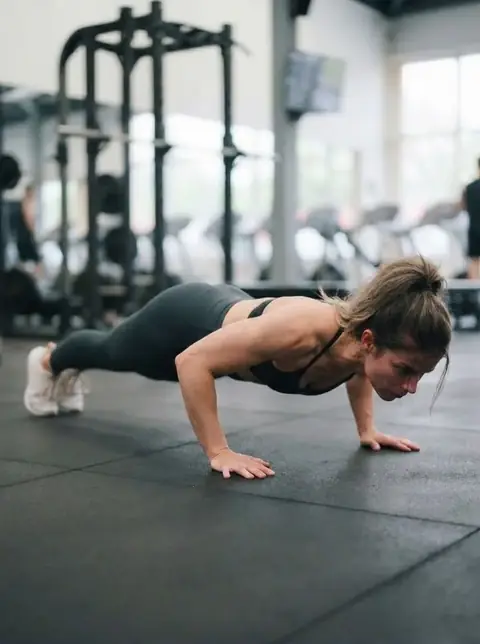
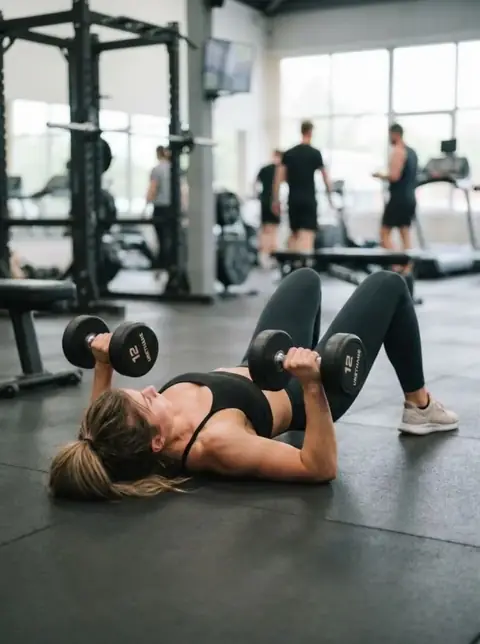
For the decline push-up, rest your feet on a sturdy chair or the edge of the bed. If it's still too hard, start with your feet on a step. If you don't have dumbbells, swap the last exercise for more sets of push-ups. Find more ideas in the home workouts.
How many sets to do and common mistakes
To build muscle, what matters most is how many hard sets each muscle gets per week (Schoenfeld, Ogborn and Krieger, 2017). The ACSM links the most growth to 10 or more sets per muscle per week, with gains leveling off around 18 to 20 (Currier et al., 2026). Those sets count for your whole chest: don't add an extra day just for the upper part, give incline exercises more room within your chest days.
- Setting the bench too high. Past 45°, the press looks more and more like a shoulder press: the front delt peaked at 60° (Rodríguez-Ridao et al., 2020).
- Dropping the flat press. To work the whole chest, combine the flat and incline press (Trebs et al., 2010).
- Going only halfway down. Full range of motion builds more strength than partial reps (Pallarés et al., 2021). On the incline, lower the bar to your upper chest.
- Going to failure on every set. Reaching failure doesn't build more muscle than stopping close to it (Refalo et al., 2023). Leave 1 to 3 reps in reserve.
- Resting too little. Resting more than 60 seconds has a small benefit, and past 90 it barely changes (Singer et al., 2024).
- Log every set. Weight and reps, so you know what to beat next time.
- Add reps first. When you reach the top of the range on every set, add weight.
- Work out your loads. With the 1RM calculator you estimate your max and pick the weight for each range.
The full rule is in the progressive overload guide.
Questions
What incline is best for the upper chest?
Between 30° and 45°. In studies, the upper chest worked harder in that range than on a flat bench, and above 45° the shoulders take over more and more of the work (Rodríguez-Ridao et al., 2020).
Can you isolate the upper chest?
Not completely. The pectoralis is one muscle, but the angle changes how hard each part works. Incline presses and flys load the upper part more than a flat or decline press.
Does the incline press grow the upper chest more?
In an 8-week trial with untrained men, yes: the upper chest grew more with the incline press than with the flat press (Chaves et al., 2020).
How do you work the upper chest at home?
With decline push-ups, feet on a chair or bench. The full session is laid out above.
How many times a week should you train the upper chest?
Within your chest days, 1 or 2 times a week. Just open each session with an incline press and add one more exercise for the upper part.
Sources
- Lauver JD, Cayot TE, Scheuermann BW. Influence of bench angle on upper extremity muscular activation during bench press exercise. Eur J Sport Sci. 2016;16(3):309-316. doi:10.1080/17461391.2015.1022605
- Trebs AA, Brandenburg JP, Pitney WA. An electromyography analysis of 3 muscles surrounding the shoulder joint during the performance of a chest press exercise at several angles. J Strength Cond Res. 2010;24(7):1925-1930. doi:10.1519/JSC.0b013e3181ddfae7
- Rodríguez-Ridao D, Antequera-Vique JA, Martín-Fuentes I, Muyor JM. Effect of five bench inclinations on the electromyographic activity of the pectoralis major, anterior deltoid, and triceps brachii during the bench press exercise. Int J Environ Res Public Health. 2020;17(19):7339. doi:10.3390/ijerph17197339
- Chaves SFN, Rocha-Júnior VA, Encarnação IGA, et al. Effects of horizontal and incline bench press on neuromuscular adaptations in untrained young men. Int J Exerc Sci. 2020. doi:10.70252/fdnb1158
- Nunes JP, Grgic J, Cunha PM, et al. What influence does resistance exercise order have on muscular strength gains and muscle hypertrophy? A systematic review and meta-analysis. Eur J Sport Sci. 2021. doi:10.1080/17461391.2020.1733672
- Kikuchi N, Nakazato K. Low-load bench press and push-up induce similar muscle hypertrophy and strength gain. J Exerc Sci Fit. 2017. doi:10.1016/j.jesf.2017.06.003
- Schoenfeld BJ, Grgic J, Ogborn D, Krieger JW. Strength and hypertrophy adaptations between low- vs. high-load resistance training: a systematic review and meta-analysis. J Strength Cond Res. 2017. doi:10.1519/JSC.0000000000002200
- Schoenfeld BJ, Ogborn D, Krieger JW. Dose-response relationship between weekly resistance training volume and increases in muscle mass: a systematic review and meta-analysis. J Sports Sci. 2017. doi:10.1080/02640414.2016.1210197
- Currier BS, D'Souza AC, Singh MAF, et al. American College of Sports Medicine Position Stand. Resistance training prescription for muscle function, hypertrophy, and physical performance in healthy adults: an overview of reviews. Med Sci Sports Exerc. 2026. doi:10.1249/MSS.0000000000003897
- Pallarés JG, Hernández-Belmonte A, Martínez-Cava A, et al. Effects of range of motion on resistance training adaptations: a systematic review and meta-analysis. Scand J Med Sci Sports. 2021. doi:10.1111/sms.14006
- Refalo MC, Helms ER, Trexler ET, Hamilton DL, Fyfe JJ. Influence of resistance training proximity-to-failure on skeletal muscle hypertrophy: a systematic review with meta-analysis. Sports Med. 2023. doi:10.1007/s40279-022-01784-y
- Singer A, Wolf M, Generoso L, et al. Give it a rest: a systematic review with Bayesian meta-analysis on the effect of inter-set rest interval duration on muscle hypertrophy. Front Sports Act Living. 2024. doi:10.3389/fspor.2024.1429789
This guide is for information only and does not replace advice from a health professional.