What lower abs are and which exercises train them
The rectus abdominis is a single muscle that runs from your ribs to your pubic bone. What people call the lower abs is its bottom part, between your belly button and your pelvis. It has no tendon of its own and does not move on its own: when the rectus abdominis contracts, the whole muscle works.
What does change is how active each region is in each exercise, but without a clear pattern. A systematic review of 67 studies that measured trunk muscle activity gathered results going both ways: in the crunch the upper part was more active than the lower part, and in the sit-up it was the other way around (Oliva-Lozano and Muyor, 2020). No exercise trains only the lower part, so the real goal is to train the whole rectus abdominis well, with more exercises that move your pelvis.
The exercises linked to the lower abs have one thing in common: your pelvis moves toward your ribs instead of your shoulders moving toward your hips. The key is the end of the movement: if you only lift your legs, your hip flexors do most of the work; if you also curl your pelvis and lift your tailbone, your abs do it.
- Reverse crunch. The reverse crunch is the easiest to learn: lying down, you bring your knees to your chest and lift your hips off the floor.
- Hanging leg raise. The hanging leg raise is the hardest version, because the weight of your legs hangs far from your body. If you can't do it yet, start with the hanging knee raise.
- Lying or bench leg raise. The leg raise and the bench leg raise work at home or at the gym. Keep your lower back on the floor or bench the whole time.
- Hollow hold. In the hollow hold you hold your body in a banana shape with your lower back pressed into the floor. It teaches the same pelvic position the other exercises need.
- Ab wheel rollout. The ab wheel rollout makes your abs stop your lower back from arching as you reach out.
Lower ab workout at the gym
A pull-up bar and a cable machine cover everything. This session starts with the hardest exercise, while you are fresh, and adds a loaded crunch so the whole rectus abdominis keeps progressing. Do it at the end of your workout.
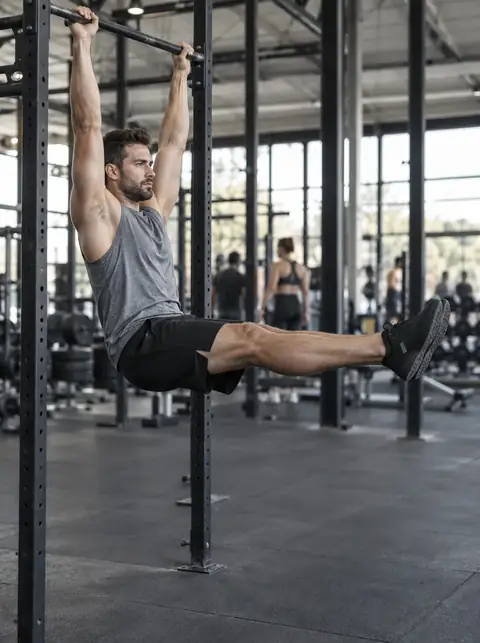
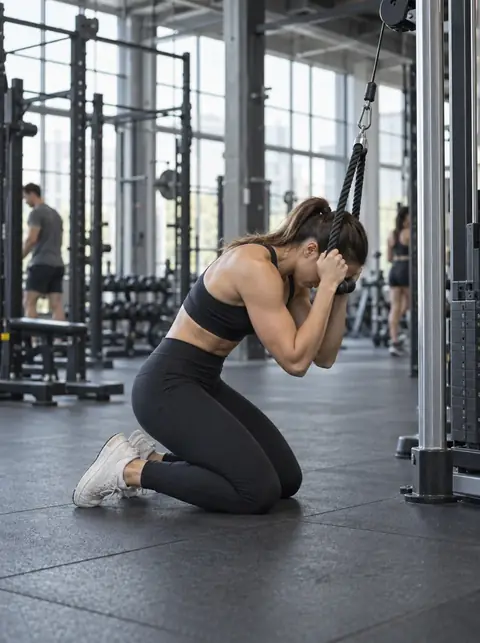
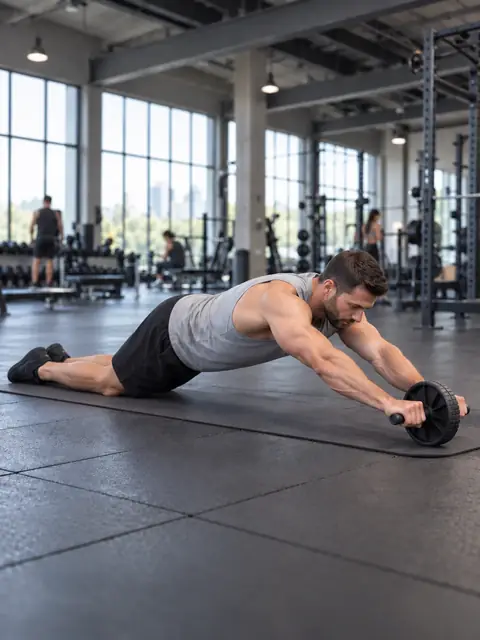
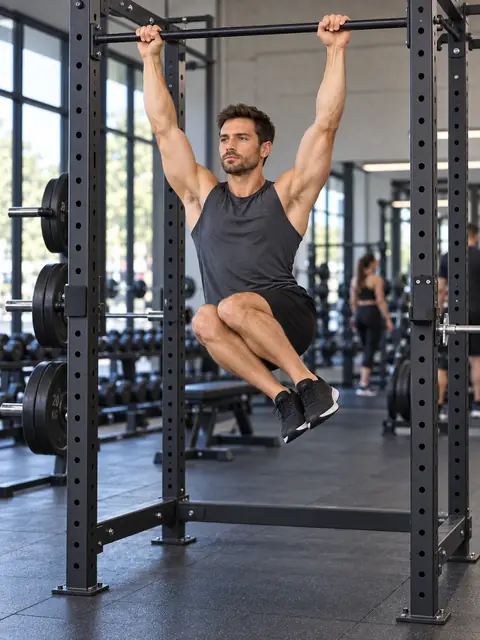
If you swing on the bar, pause for one second at the bottom of each rep. If you can't do 8 clean leg raises, swap them for hanging knee raises.
Lower ab workout at home
At home your body is the load, and that is enough: muscle grows about the same with light or heavy loads when sets end close to failure (Schoenfeld et al., 2017). That is why the rep ranges are higher. All you need is the floor or a mat.
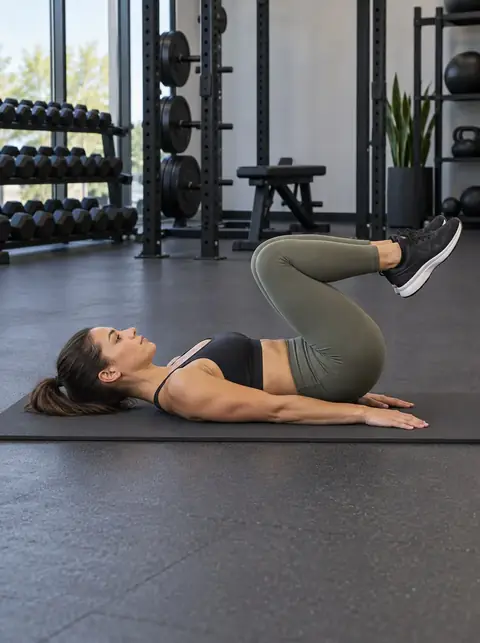
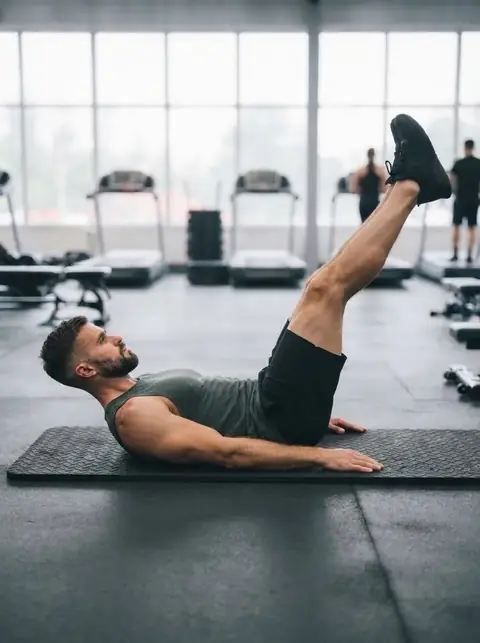
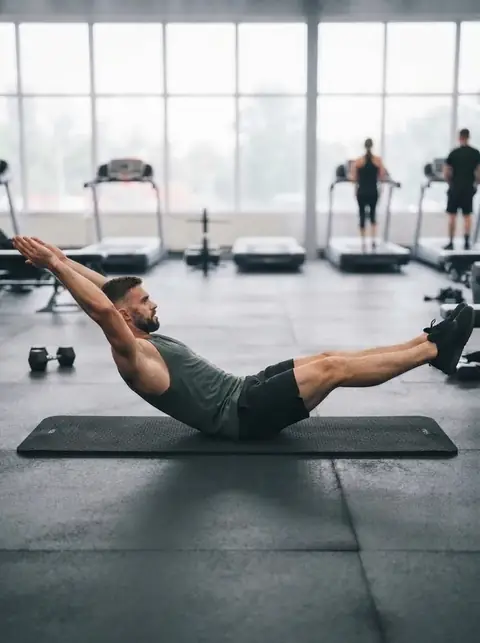
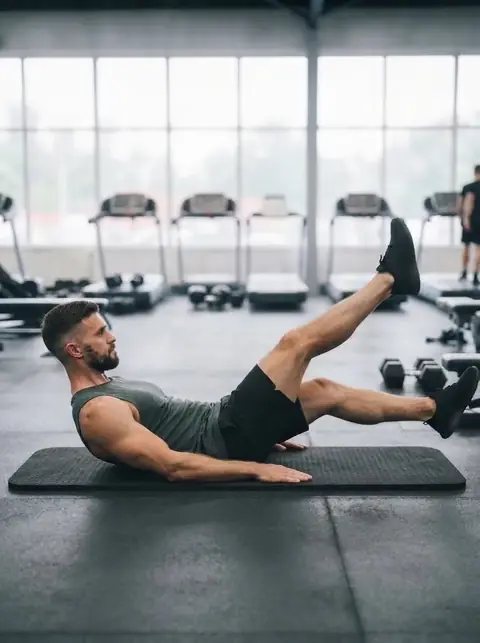
To make the reverse crunch harder, lower it over 3 seconds. For the leg raise, straighten your knees more: the farther the weight of your legs, the harder your abs work.
Lower ab workout for beginners
If you are just starting out or your lower back bothers you when you raise straight legs, start with bent-knee versions. First learn to keep your lower back down; then lengthen the lever.
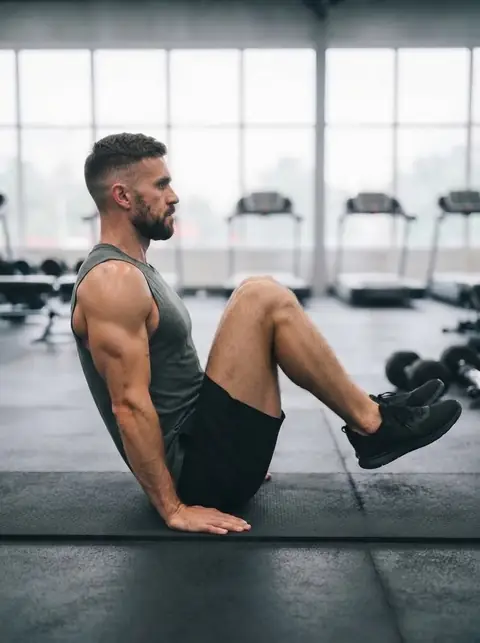
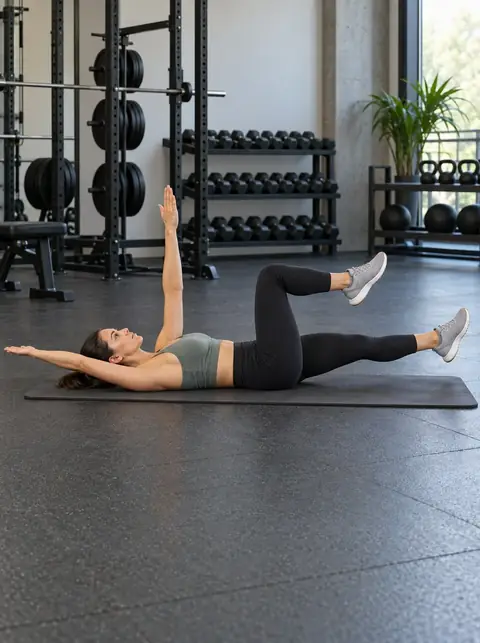
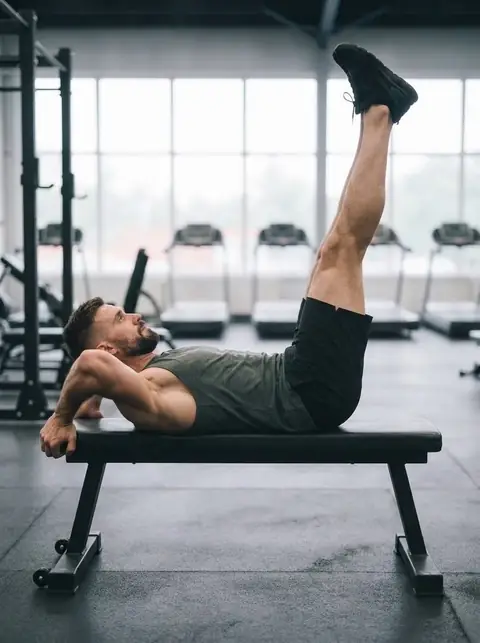
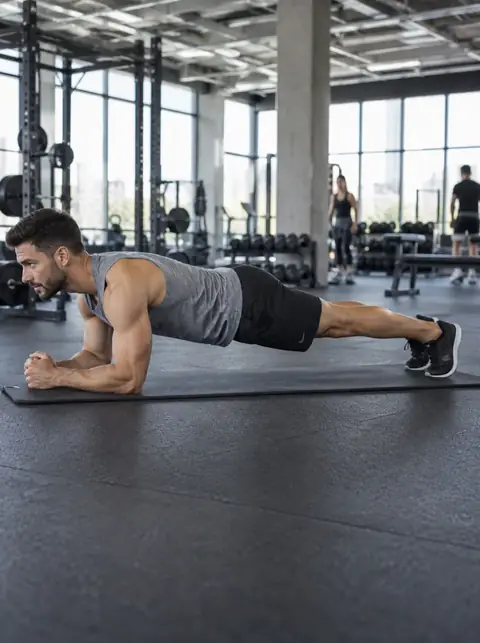
Once you hit 15 clean reps on every set, move on to the home workout. For a workout that covers your whole core, see the ab workout guide.
How many lower ab sets to do per week
Your lower abs are not trained apart from the rest of your abs, so count all your ab sets together. The ACSM links the most hypertrophy to 10 or more sets per muscle per week, with gains leveling off around 18 to 20 (Currier et al., 2026). Those figures are for muscles in general: use them as a guide.
| Level | Sets per week | Sessions | Suggested workout |
|---|---|---|---|
| Beginner | 6 to 8 | 1 or 2 | For beginners |
| Intermediate | 10 to 12 | 2 | At home or at the gym |
| Advanced | 12 to 16 | 2 or 3 | At the gym, split over 2 days |
At the same volume, training a muscle once or twice a week gives similar growth (Schoenfeld, Grgic and Krieger, 2019).
Why exercises alone won't make your lower abs show
Training your abs strengthens the muscle, but it does not burn the fat covering it. In a trial with sedentary adults, doing ab exercises 5 days a week for 6 weeks on a diet that kept their weight stable did not reduce belly fat (Vispute et al., 2011). A meta-analysis also found no less fat over the trained area than over the untrained one (Ramirez-Campillo et al., 2022).
So even when the muscle is strong, your lower abs only show once you lose fat across your whole body, and that takes a steady calorie deficit; you can estimate where you are with the body fat calculator. The full process is in the guide on how to get visible abs.
Common lower ab training mistakes
- Raising your legs without curling your pelvis. If your hips don't lift or tilt back, your hip flexors take over. Think about bringing your pubic bone toward your belly button.
- Arching your lower back. When your legs go down and your lower back lifts off the floor, the lever is too long for you. Bend your knees or shorten the range.
- Swinging on the bar. Momentum makes reps easier and takes work away from your abs. Go up and down under control.
- Doing sets that feel easy. You don't need to reach failure to grow (Refalo et al., 2023), but you do need to finish close to it. If you have many reps left, move to a harder variation.
- Expecting exercises alone to make them show. Without losing fat, the muscle grows underneath and stays hidden. Training and eating in a deficit go together.
How to progress your lower ab exercises
- Log every set. Reps or seconds for each exercise, so you know what to beat next time.
- Add reps first. Once you reach the top of the range on every set, make it harder. Adding reps and adding load both worked in trained people (Plotkin et al., 2022).
- Lengthen the lever. From bent knees to straight legs, from the floor to the bar: reverse crunch, leg raise, hanging knee raise and hanging leg raise.
- Lower more slowly. Taking 3 seconds on the way down makes any exercise harder without changing variations.
The full rule is in the progressive overload guide.
Questions
Can you train only your lower abs?
No. They are part of the rectus abdominis, which contracts as a whole. Exercises that move your pelvis may load the lower part a bit more, but in studies the result changes from one exercise to another (Oliva-Lozano and Muyor, 2020).
What is the best lower ab exercise?
The hanging leg raise if you are already strong, and the reverse crunch if you are starting out. In both, what matters is curling your pelvis as you lift.
How do I lose lower belly fat?
With a calorie deficit that lowers fat across your whole body. Ab exercises don't burn fat from that specific area (Vispute et al., 2011).
Why does my lower back hurt during leg raises?
It usually happens when your lower back arches as your legs go down. Bend your knees or shorten the range until you can keep it down. If the pain continues, see a health professional.
Sources
- Oliva-Lozano JM, Muyor JM. Core muscle activity during physical fitness exercises: a systematic review. Int J Environ Res Public Health. 2020;17(12):4306. doi:10.3390/ijerph17124306
- Vispute SS, Smith JD, LeCheminant JD, Hurley KS. The effect of abdominal exercise on abdominal fat. J Strength Cond Res. 2011;25(9):2559-2564. doi:10.1519/JSC.0b013e3181fb4a46
- Ramirez-Campillo R, Andrade DC, Clemente FM, Afonso J, Pérez-Castilla A, Gentil P. A proposed model to test the hypothesis of exercise-induced localized fat reduction (spot reduction), including a systematic review with meta-analysis. Hum Mov. 2022;23(3):1-14. doi:10.5114/hm.2022.110373
- Schoenfeld BJ, Grgic J, Ogborn D, Krieger JW. Strength and hypertrophy adaptations between low- vs. high-load resistance training: a systematic review and meta-analysis. J Strength Cond Res. 2017. doi:10.1519/JSC.0000000000002200
- Currier BS, D'Souza AC, Singh MAF, et al. American College of Sports Medicine Position Stand. Resistance training prescription for muscle function, hypertrophy, and physical performance in healthy adults: an overview of reviews. Med Sci Sports Exerc. 2026. doi:10.1249/MSS.0000000000003897
- Schoenfeld BJ, Grgic J, Krieger J. How many times per week should a muscle be trained to maximize muscle hypertrophy? A systematic review and meta-analysis of studies examining the effects of resistance training frequency. J Sports Sci. 2019. doi:10.1080/02640414.2018.1555906
- Refalo MC, Helms ER, Trexler ET, Hamilton DL, Fyfe JJ. Influence of resistance training proximity-to-failure on skeletal muscle hypertrophy: a systematic review with meta-analysis. Sports Med. 2023. doi:10.1007/s40279-022-01784-y
- Plotkin D, Coleman M, Van Every D, et al. Progressive overload without progressing load? The effects of load or repetition progression on muscular adaptations. PeerJ. 2022. doi:10.7717/peerj.14142
This guide is for information only and does not replace advice from a health professional.