Macro calculator to lose fat or build muscle
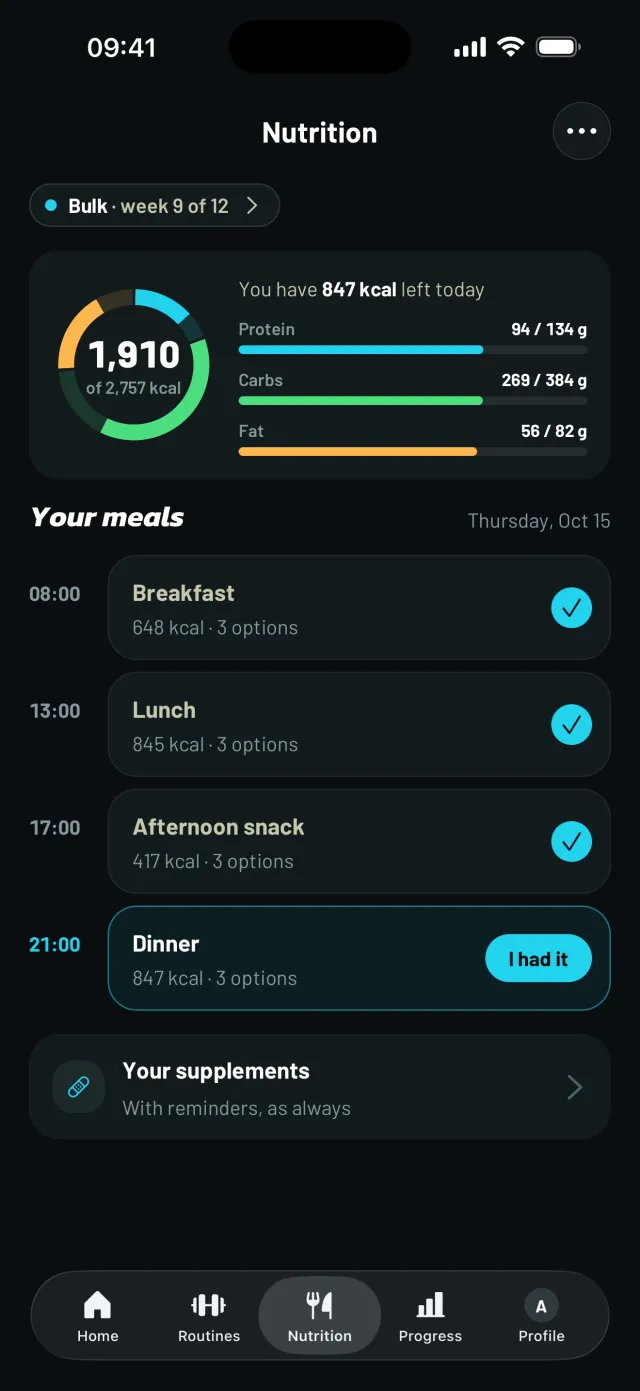
Calculate how many grams of protein, carbs and fat to eat a day to lose fat, maintain or build muscle. They're the same rules the Mobbe app uses to set your daily target.
It's an estimate, not a measurement. In the app, reviews compare it with your real weight and suggest adjustments. It doesn't replace a professional: during pregnancy or breastfeeding, or with an eating disorder, diabetes, kidney disease or weight-loss treatment, the app doesn't calculate targets and suggests seeing a professional.
Take it to your plan. Mobbe builds your routine for free and, with PRO, your meals with these grams.
How we calculate
The same calculation the Mobbe app does, step by step and with the worked example.
- Step 1
Your calories
First, your daily target: your maintenance with the pace you choose to lose or gain, as in the calorie calculator. In the example (a 30-year-old man, 180 cm, 85 kg, 4 training days a week, losing weight) it's 2,250 kcal.
Mifflin-St Jeor and NASEM, 2023. Paces from Helms, 2014 and Garthe, 2011. - Step 2
Protein first
Per kg of weight: 2.0 g to lose, 1.6 to maintain and 1.8 to build muscle (2.0 if you're vegan). From age 65, 0.2 more. With a BMI of 27.5 or more, a reference weight is used, the one you'd have at a BMI of 27.5, except when building muscle. In the example: 2.0 × 85 = 170 g.
protein = g per kg × weight (or reference weight)Helms, 2014; Hector and Phillips, 2018; Morton, 2018; Iraki, 2019. Older adults: PROT-AGE, 2013. Reference weight: Weijs, 2025. - Step 3
Fat
1 g per kg of weight (or reference weight), always between 20 and 35% of calories and never below 0.5 g per kg. In the example: 85 g, 34% of calories.
ISSN, 2018 (Kerksick and colleagues) and IOM, 2005. - Step 4
Carbs and fiber
Carbs fill in the rest of the calories, with a minimum of 130 g. If they fall short, fat goes down to its floor first and, only when losing weight, protein down to 1.6 g per kg. In the example: (2,250 − 4 × 170 − 9 × 85) ÷ 4 = 201 g. Fiber: 14 g per 1,000 kcal, at least 25 g (32 g in the example).
carbs = (kcal − 4 × protein − 9 × fat) ÷ 4IOM, 2005.
Sources
- Mifflin MD, St Jeor ST, Hill LA, Scott BJ, Daugherty SA, Koh YO. A new predictive equation for resting energy expenditure in healthy individuals. Am J Clin Nutr. 1990;51(2):241-247. doi:10.1093/ajcn/51.2.241
- National Academies of Sciences, Engineering, and Medicine. Dietary Reference Intakes for Energy. Washington, DC: The National Academies Press; 2023. doi:10.17226/26818
- Helms ER, Aragon AA, Fitschen PJ. Evidence-based recommendations for natural bodybuilding contest preparation: nutrition and supplementation. J Int Soc Sports Nutr. 2014;11:20. doi:10.1186/1550-2783-11-20
- Helms ER, Zinn C, Rowlands DS, Brown SR. A systematic review of dietary protein during caloric restriction in resistance trained lean athletes: a case for higher intakes. Int J Sport Nutr Exerc Metab. 2014;24(2):127-138. doi:10.1123/ijsnem.2013-0054
- Hector AJ, Phillips SM. Protein recommendations for weight loss in elite athletes: a focus on body composition and performance. Int J Sport Nutr Exerc Metab. 2018;28(2):170-177. doi:10.1123/ijsnem.2017-0273
- Morton RW, Murphy KT, McKellar SR, et al. A systematic review, meta-analysis and meta-regression of the effect of protein supplementation on resistance training-induced gains in muscle mass and strength in healthy adults. Br J Sports Med. 2018;52(6):376-384. doi:10.1136/bjsports-2017-097608
- Iraki J, Fitschen P, Espinar S, Helms E. Nutrition recommendations for bodybuilders in the off-season: a narrative review. Sports (Basel). 2019;7(7):154. doi:10.3390/sports7070154
- Bauer J, Biolo G, Cederholm T, et al. Evidence-based recommendations for optimal dietary protein intake in older people: a position paper from the PROT-AGE Study Group. J Am Med Dir Assoc. 2013;14(8):542-559. doi:10.1016/j.jamda.2013.05.021
- Weijs PJM. Protein requirement in obesity. Curr Opin Clin Nutr Metab Care. 2025;28(1):27-32.
- Kerksick CM, Wilborn CD, Roberts MD, et al. ISSN exercise & sports nutrition review update: research & recommendations. J Int Soc Sports Nutr. 2018;15(1):38. doi:10.1186/s12970-018-0242-y
- Institute of Medicine. Dietary Reference Intakes for Energy, Carbohydrate, Fiber, Fat, Fatty Acids, Cholesterol, Protein, and Amino Acids. Washington, DC: National Academies Press; 2005. doi:10.17226/10490
- Garthe I, Raastad T, Refsnes PE, Koivisto A, Sundgot-Borgen J. Effect of two different weight-loss rates on body composition and strength and power-related performance in elite athletes. Int J Sport Nutr Exerc Metab. 2011;21(2):97-104. doi:10.1123/ijsnem.21.2.97
Frequently asked questions
How are macros calculated?
You start from your daily calories. First protein is set per kg of weight based on your goal, then fat (1 g per kg, between 20 and 35% of calories), and carbs fill in what's left, with a minimum of 130 g. Each gram of protein or carbs provides 4 kcal and each gram of fat, 9.
What macros do I need to build muscle?
Protein at 1.8 g per kg (2.0 if you're vegan), fat at 1 g per kg and the rest in carbs, with a small calorie surplus. A 30-year-old man, 180 cm and 85 kg, who trains 4 days a week needs about 3,150 kcal: 153 g of protein, 443 g of carbs and 85 g of fat.
What macros should I use to lose fat?
More protein (2.0 g per kg) to protect your muscle, fat at 1 g per kg and carbs with what's left of your deficit. At 85 kg and 4 training days: 2,250 kcal, 170 g of protein, 201 g of carbs and 85 g of fat. A 30-year-old woman, 165 cm and 62 kg, who trains 3 days: 1,800 kcal, 124 g of protein, 187 g of carbs and 62 g of fat.
How much fiber should I eat?
About 14 g per 1,000 kcal, and at least 25 g a day (IOM 2005). At 2,250 kcal that's 32 g.
Does it work if I'm vegetarian or vegan?
Yes. Choose your diet in the calculator: if you're vegan, protein goes up to 2.0 g per kg when building muscle. In every other case the grams are the same; what changes is which foods they come from.
Why does the calculator use a reference weight?
Because with a lot of body fat, calculating protein and fat on total weight gives higher numbers than you need. With a BMI of 27.5 or more it uses the weight you'd have at a BMI of 27.5 (Weijs 2025). When building muscle, protein is calculated on your real weight.
Guides to get more out of it
More calculators and routines
- Calorie calculatorYour maintenance and your target to lose, maintain or gain weight, compared with Mifflin-St Jeor and Harris-Benedict.Calculate →
- Protein calculatorGrams of protein a day based on your weight and your goal, with a 50 to 100 kg table.Calculate →
- 1RM calculatorYour one-rep max with Epley and Brzycki, by RIR or RPE, and your training weights from 50 to 100%.Calculate →
Mobbe builds your plan with these numbers
Download Mobbe and answer a few questions: it builds your routine for free and, with PRO, your meal plan with grams and macros comes from these same calculations. Swap a food and it recalculates the grams.