Enter the weight and reps from a set of barbell bench press and we'll give you your estimated 1RM, without testing your max. Below you'll find your training weights from 50 to 100%.
It's an estimate for the technique of your set, not a test of your max.
Take it to your routine. In Mobbe you log your bench press sets and see your estimated 1RM, for free.
They update with the calculator. Right now they show a 1RM of 91.7 kg.
Training weights from 50 to 100% of your 1RM
% 1RM
Weight
To load
Reps
50%
45.9 kg101.2 lb
45 kg
—
55%
50.4 kg111.1 lb
50 kg
—
60%
55 kg121.3 lb
55 kg
—
65%
59.6 kg131.4 lb
60 kg
—
70%
64.2 kg141.5 lb
65 kg
—
75%
68.8 kg151.7 lb
70 kg
10
80%
73.4 kg161.8 lb
72.5 kg
8
85%
77.9 kg171.7 lb
77.5 kg
5
90%
82.5 kg181.9 lb
82.5 kg
3
95%
87.1 kg192 lb
87.5 kg
2
100%
91.7 kg202.2 lb
92.5 kg
1
1RM percentage by reps, to failure
Reps
Epley
Brzycki
1
100%
100%
2
93.8%
97.2%
3
90.9%
94.4%
4
88.2%
91.7%
5
85.7%
88.9%
6
83.3%
86.1%
7
81.1%
83.3%
8
78.9%
80.6%
9
76.9%
77.8%
10
75%
75%
11
73.2%
72.2%
12
71.4%
69.4%
“To load” rounds to 2.5 kg, what you can put together with plates. Reps come from Epley and are shown up to 12.
Your result
What your bench press 1RM tells you
What it measures
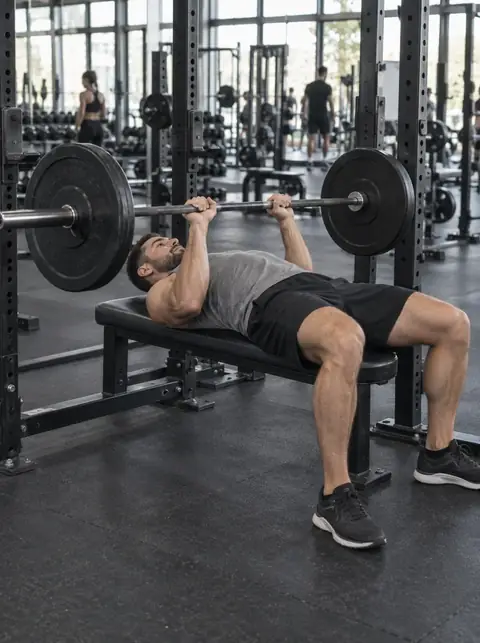
The weight you could do a single full rep with: the bar comes down to touch your chest and goes up until your arms are straight. It holds for the technique of your set: if the bar bounced off your chest, the estimate includes the bounce.
How accurate it is
In 67 untrained people, the estimated 1RM closely tracked the real one (correlation above 0.95). Even so, on the bench press the mean difference was significant for 5 of the 7 formulas tested (LeSuer et al., 1997).
Which set to use
A recent, heavy set, taken to failure or with your reps in reserve noted. Count only full reps, with your glutes on the bench.
Safety
Before you test your bench press max
If you want to confirm the number with a real rep, set this up first.
Safety bars or a spotterIf you fail, the bar ends up on your chest. Do it in a rack with the safety bars set a little below your chest, or with someone behind the bench who knows how to spot you.
Wrap your thumb around the barGrip the bar with your thumb wrapped around it. Without the thumb, the bar can slip out of your hands and fall.
Same as your setSame grip, feet firm on the floor and glutes on the bench. If you lift your hips to press more weight, that number doesn't compare with your estimate.
Warm up with increasing weights and rest a few minutes between the heaviest attempts. If you have pain or an injury, stick with the estimate and don't test your max.
The method
How we calculate
The formulas, with the example set: 80 kg × 5 reps to failure. For pull-ups and dips, use the general 1RM calculator.
Step 1
Epley
The formula the Mobbe app uses. With the example set: 80 × (1 + 5 ÷ 30) = 93.3 kg.
1RM = weight × (1 + reps ÷ 30)
Epley, 1985.
Step 2
Brzycki and the average
80 × 36 ÷ (37 − 5) = 90 kg. Your estimated bench press 1RM is the average of the two: 91.7 kg.
1RM = weight × 36 ÷ (37 − reps)
Brzycki, 1993.
Step 3
RIR and RPE
If you didn't reach failure, we add the reps you had left (RIR). 80 kg × 5 at RPE 8 (2 in reserve) counts as 7 to failure: 97.3 kg.
reps to failure = reps done + RIR
Zourdos, 2016; Helms, 2016.
Step 4
How many reps to use
Reynolds et al. (2006) compared sets of 5, 10 and 20 reps to failure on the bench press and leg press: the set of 5 predicted 1RM best. They recommend not going above 10 reps with linear formulas like Epley. The calculator accepts up to 12.
Reynolds, 2006.
Sources
Epley B. Poundage chart. Boyd Epley Workout. Lincoln, NE: Body Enterprises; 1985.
Brzycki M. Strength testing: predicting a one-rep max from reps-to-fatigue. J Phys Educ Recreat Dance. 1993;64(1):88-90.
Zourdos MC, Klemp A, Dolan C, et al. Novel resistance training-specific rating of perceived exertion scale measuring repetitions in reserve. J Strength Cond Res. 2016;30(1):267-275. doi:10.1519/JSC.0000000000001049
Helms ER, Cronin J, Storey A, Zourdos MC. Application of the repetitions in reserve-based rating of perceived exertion scale for resistance training. Strength Cond J. 2016;38(4):42-49.
Reynolds JM, Gordon TJ, Robergs RA. Prediction of one repetition maximum strength from multiple repetition maximum testing and anthropometry. J Strength Cond Res. 2006;20(3):584-592. doi:10.1519/R-15304.1
LeSuer DA, McCormick JH, Mayhew JL, Wasserstein RL, Arnold MD. The accuracy of prediction equations for estimating 1-RM performance in the bench press, squat, and deadlift. J Strength Cond Res. 1997;11(4):211-213.
Technique
Bench press exercises
How to do each one step by step, with a photo and the muscles it works.